
We see this pattern a lot. A company runs three AI pilots and presents a polished deck to leadership. Twelve months later, nothing is in production.
The pilots weren’t bad ideas. What was missing was an AI implementation roadmap that said what happens next, who owns it, and what has to be true before moving forward.
This guide lays out six phases from pilot to production. Each one comes with its deliverables, a typical timeline, an estimated cost, and the gate to pass before starting the next.
What a Usable Roadmap Contains
A usable AI implementation roadmap is a phased plan that takes one AI use case from assessment to production. It names an owner for each phase, sets measurable criteria for moving forward, and attaches a budget to every stage.
It’s not the same as an AI implementation strategy. Strategy decides why you’re using AI and which problems matter. The roadmap decides when, who, and in what order.
Every roadmap worth following has four parts:
- Phases - Clear stages with a defined start and finish, not an open-ended “AI initiative.”
- Owners - One named person accountable for each phase, and for the system after launch.
- Gates - Criteria that must be met before the next phase gets funded.
- Budget - Hours and costs per phase, so nobody gets surprised in month five.
If the roadmap you’ve been handed is missing any of these, it’s a vision document. Useful, but not something a team can execute.
Before You Start: How We Evaluate AI Readiness
Before building a roadmap, we score every organization on four criteria. Rate yourself from 1 to 5 on each, and the total tells you where to start.
Data access and quality
Can your team actually pull the data the AI would need, and is it accurate? Data locked in spreadsheets, PDFs, or a vendor system you can’t query scores low.
Integration surface
Count the systems the AI would need to read from or write to. One system is simple. Five systems with different owners and APIs is a project in itself.
Process ownership
Is there a named person who will own the outcome after launch? Without an owner, the system quietly decays within months.
Risk and compliance exposure
HIPAA, CCPA, financial regulations, or strict internal policies all add review steps. Higher exposure means a longer governance phase, not a reason to stop.
Scoring 15 or above out of 20? You can move quickly through Phase 1. Below 10, expect the readiness work to take longer than anything that follows. That’s normal, and fixing it early costs far less than fixing it mid-build.
The 6 Phases From Pilot to Production
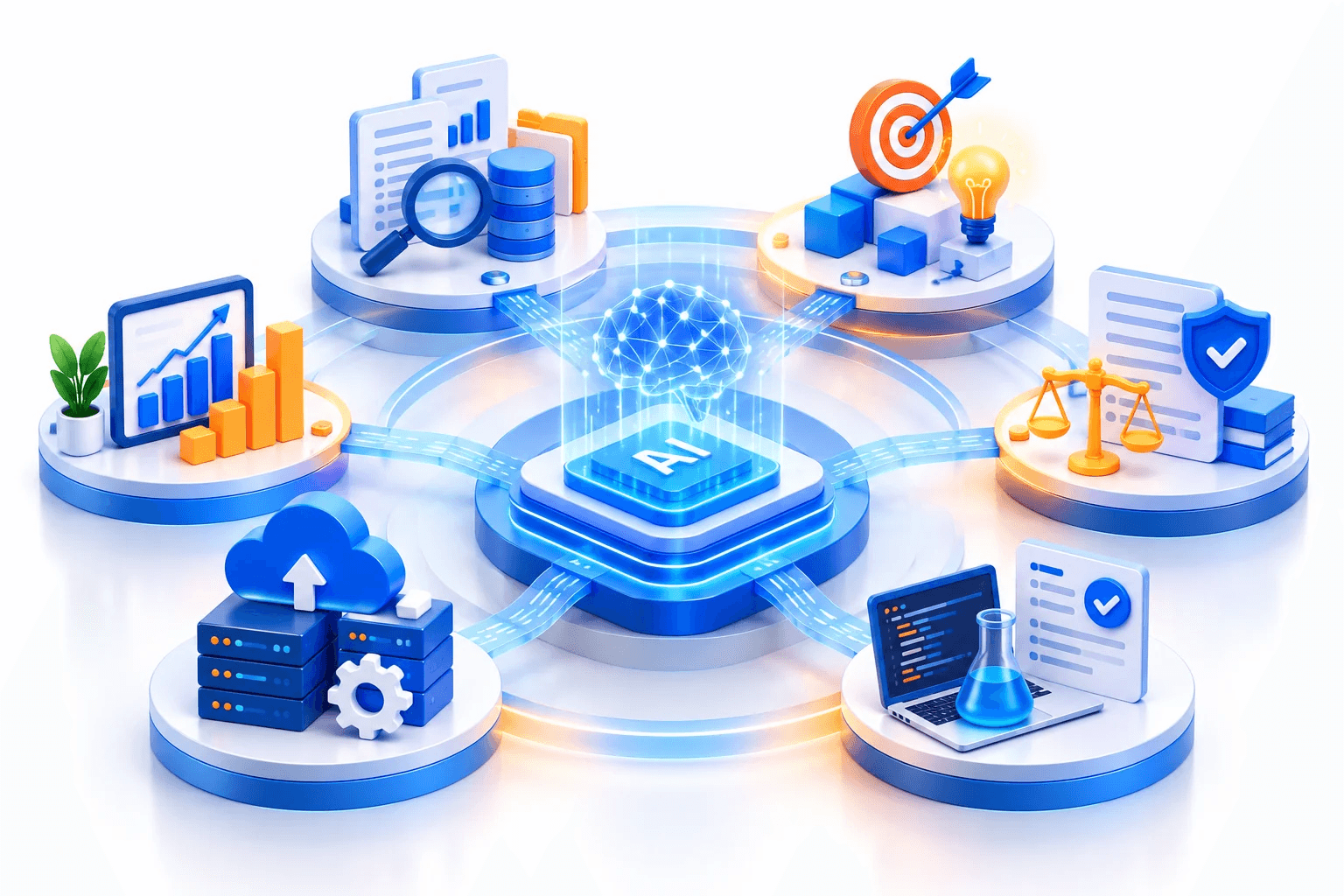
Each phase below ends with a gate. In our experience, skipped gates are the reason most stalled projects stall.
Phase 1: Readiness Assessment
This phase maps what you have before you decide what to build. It covers systems, data sources, data owners, and compliance constraints, and usually takes two to four weeks.
The deliverable is a systems and data inventory with a readiness score attached. For an enterprise AI implementation, this inventory is almost always bigger than anyone expects.
We saw this firsthand building a digital governance platform for a global enterprise. The platform assessed more than 1,800 systems and classified each one by risk automatically, which improved compliance by 23%. You can’t plan AI around systems you haven’t mapped.
Gate to Phase 2: Data sources are mapped, an owner is named, and compliance constraints are documented.
Phase 2: Use-Case Prioritization
Now you pick what to build first. List every candidate use case, then score each one on business impact and on feasibility, using your readiness results.
Pick one. The highest-impact idea that fails on feasibility goes to the backlog, not the build queue.
| Business function | Common first use case |
|---|---|
| Customer support | AI chatbot answering from your knowledge base |
| Finance | Invoice and bill verification |
| Sales | Lead scoring and CRM data enrichment |
| Operations | Demand forecasting |
| HR | Resume screening and internal policy Q&A |
Gate to Phase 3: One use case is selected, and its current performance is recorded as a baseline. Without a baseline, you can’t prove the AI worked.
Phase 3: Strategy and Governance
This phase turns the chosen use case into an approved plan. The big decision is whether to build custom, buy an existing tool, or integrate an AI service into your current systems.
Your AI implementation strategy should also set the rules: what data the AI can access, who reviews its outputs, and what happens when it gets something wrong. Expect two to three weeks, longer in regulated industries.
Gate to Phase 4: The budget is approved, the usage policy is signed off, and the build, buy, or integrate decision is documented with reasons.
Phase 4: Proof of Concept
The proof of concept tests whether the idea works on your real data. Set the success metric before you start, not after you see the results.
This is where most AI implementation challenges first show up. A model that looks great on clean demo data often struggles with real records full of gaps, duplicates, and odd formats.
Plan for four to eight weeks. Define kill criteria too, so everyone knows in advance which result means stop.
Gate to Phase 5: The target metric is met on real data. If it isn’t, stopping here is a good outcome. You’ve spent weeks, not a year, learning the idea isn’t ready yet.
Phase 5: Integration and Deployment
Here’s what nobody mentions in vendor decks: integration usually takes more hours than every earlier phase combined.
The AI has to connect to your live systems through APIs, handle authentication, recover from errors, and log what it does. Your team also needs training on when to trust its output and when to override it.
Teams without in-house integration experience often bring in AI integration services at this stage. Expect eight to sixteen weeks, depending on how many systems are involved.
Gate to Phase 6: The system runs stably in production for 30 days, with monitoring and alerts in place.
Phase 6: Scale and Optimize
Launch isn’t the end. Models drift as your data and customers change, so performance needs ongoing monitoring and periodic retraining.
This is also where enterprise AI implementation starts paying off. With one use case proven, you return to the Phase 2 backlog and start the next one, reusing the data pipelines and governance you’ve already built.
Gate: None. This phase loops back to Phase 2 for every new use case.
Timeline and Cost by Phase
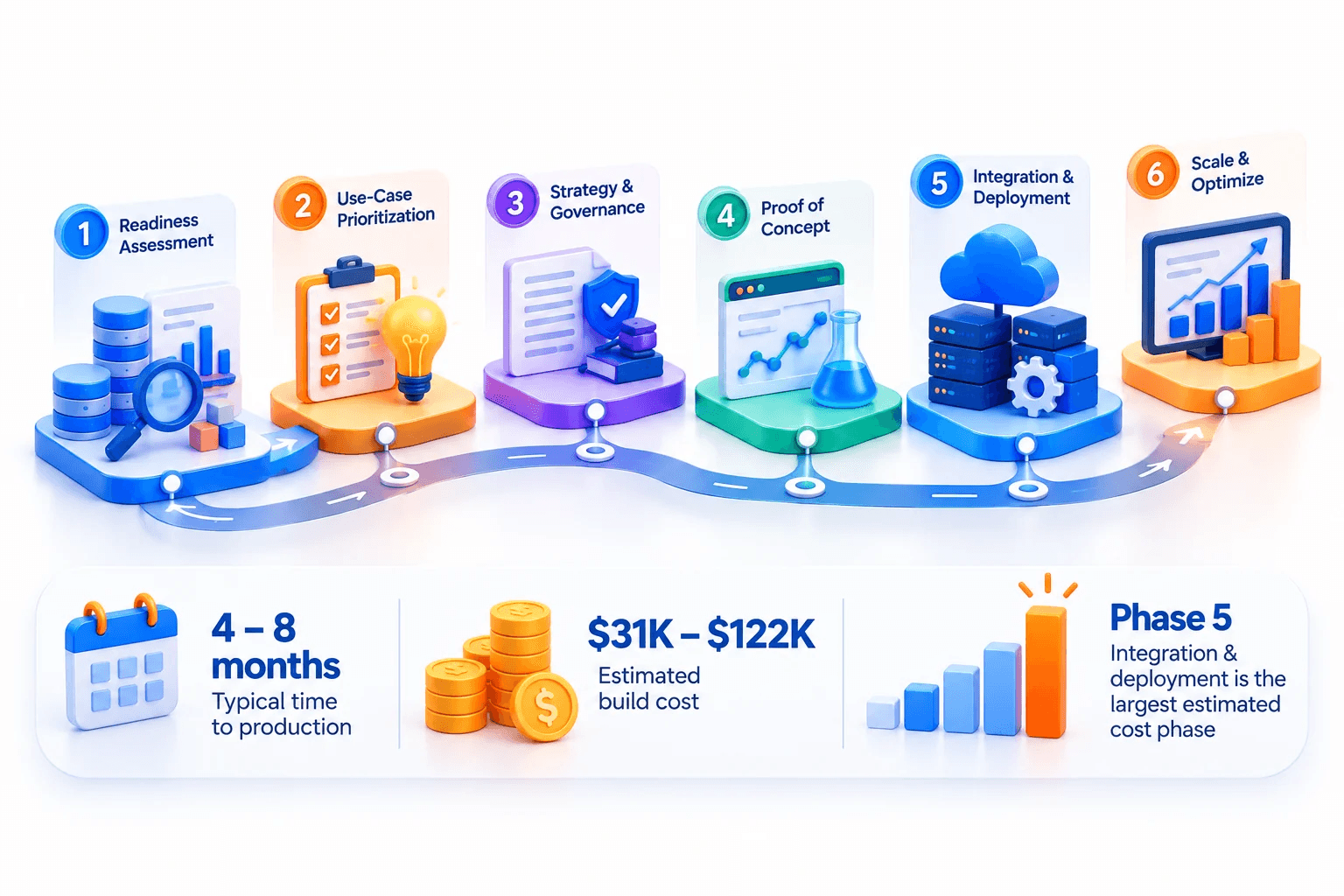
I know you scrolled here first, so here’s the math instead of a vague range.
The table below estimates hours for each phase and multiplies them by RemoteState’s published rate of $25 to $49 per hour. Treat these as planning numbers for a single use case, not a quote. Your AI implementation cost depends mostly on Phase 5, because integration scope varies more than anything else.
| Phase | Duration | Est. hours | Est. cost |
|---|---|---|---|
| 1. Readiness assessment | 2 to 4 weeks | 60 to 120 | $1,500 to $5,880 |
| 2. Use-case prioritization | 1 to 2 weeks | 30 to 60 | $750 to $2,940 |
| 3. Strategy and governance | 2 to 3 weeks | 40 to 100 | $1,000 to $4,900 |
| 4. Proof of concept | 4 to 8 weeks | 300 to 600 | $7,500 to $29,400 |
| 5. Integration and deployment | 8 to 16 weeks | 800 to 1,600 | $20,000 to $78,400 |
| 6. Scale and optimize | Ongoing | 40 to 120 per month | $1,000 to $5,880 per month |
Add it up, and one use case typically reaches production in four to eight months, at roughly $31,000 to $122,000 in build costs. A second use case usually costs less, because Phase 1 and much of Phase 3 are already done.
The costs that continue after launch
Build cost is a one-time number. Running cost isn’t. Budget for model usage fees that scale with volume, cloud hosting, monitoring, and the hours needed to retrain and maintain the system.
When you compare proposals, ask each vendor for a monthly running estimate alongside the build quote. That’s the only fair way to compare AI implementation cost across partners.
For deeper breakdowns by project type, see our guides to AI app development cost, generative AI development cost, and AI agent development cost.
Challenges We See Most Often
Across our AI work in healthcare, energy, logistics, and enterprise governance, the same AI implementation challenges keep coming up. Almost none of them are about the model itself.
- Data is messier than the assessment suggested. Teams rate their data a 4 out of 5, then find key fields can’t be matched across systems.
- The proof of concept runs on clean data. It passes, the team celebrates, and production data breaks it in the first week.
- Nobody owns the system after launch. The project team moves on, and accuracy slowly slips with no one watching.
- Integration is underestimated. Budgets are built around the model, then integration consumes most of the hours.
- Governance arrives after an incident. Writing usage rules after something goes wrong costs far more than writing them in Phase 3.
How RemoteState Builds AI Roadmaps
A roadmap on paper is the easy part. Following it gate by gate, with a team that has already hit these problems in production, is what actually gets AI out of pilot mode.
Our AI development services start with the readiness scorecard above, and we don’t skip gates, even when a client is eager to start building. Engineering runs from Noida, India, and our Santa Monica office handles contracts and accountability for US clients.
RemoteState is also an AWS Marketplace seller, with a Generative AI and Agentic AI Development on AWS professional services listing. AWS customers can engage us through the procurement process they already use.
Proof: AI inside a US energy-sharing platform
Our closest example of this roadmap in action is an AI-powered energy platform we built for a US company. The challenge wasn’t a shortage of AI ideas. It was getting AI into daily operations, where billing accuracy and energy demand actually matter.
The team built demand prediction, automated bill verification, an energy-sharing marketplace, and analytics dashboards. Bill verification shows why integration dominates: the AI is only useful if it reads live billing data and flags errors inside the workflow people already use.
A team of three delivered it in seven months. The platform reached 2,100 downloads and 10% revenue growth. Read the full case study.
If you’d like a second set of eyes on your plan, our AI implementation consulting starts with the same readiness review.
Conclusion
A good AI implementation roadmap doesn’t need to be complicated. Assess honestly, pick one use case, set gates, and budget for integration before you budget for the model.
If you’d like help scoring your readiness or planning your first use case, talk to the RemoteState team.
Frequently Asked Questions
Most AI roadmaps are vendor decks in disguise. This one maps 6 phases from pilot to production, with real costs, timelines, and the gates between them.


