

If you’re asking how much does AI app development cost, here’s the short version. With an offshore team, most AI apps cost $10K to $300K to build. The same scope at typical US agency rates costs several times more. Then plan another 15% to 25% of the build cost every year to keep it running.
I’ll skip the vague answer. You’ve probably seen quotes for the same idea range from $10,000 to over $1 million, and nobody explained the gap.
The gap is real, and it isn’t random. AI app development cost comes down to four things: how much the AI has to do, whether you build on existing models, who builds it, and what it costs to run once real users show up. Compared with general AI development cost, an app also adds design, mobile builds, and user-facing testing on top.
That last part is where most budgets break. Below is the math behind every artificial intelligence app development cost range in this guide, with a source for every rate and price we use.
How Much Does It Cost to Build an AI App?
Here’s how we break AI app development cost down. Every range below is estimated hours multiplied by a published hourly rate, so you can check the math yourself.
The hour estimates come from RemoteState’s own scoping method, explained in the “How We Estimate” section. Offshore rates are RemoteState’s Clutch-verified rates. US agency rates come from Shimira IT’s 2026 regional rate benchmark.
Costs by Complexity
| Tier | What it looks like | Effort (hours) | Offshore team | US agency |
|---|---|---|---|---|
| Basic | AI feature added to an existing app, API-based chatbot, simple classification | 400 to 800 | $10K to $39K | $60K to $200K |
| Mid | New web or mobile app with retrieval over your data, 2 to 4 integrations, admin dashboard | 1,200 to 2,500 | $30K to $123K | $180K to $625K |
| Enterprise | Fine-tuned or task-specific models, multiple connected systems, regulated data, high traffic | 3,000 to 6,000+ | $75K to $294K+ | $450K to $1.5M+ |
The cost to build an AI app jumps between tiers for one reason. Each step up adds data work. A basic app sends prompts to an existing model, while an enterprise app adds retrieval over your data, fine-tuned or task-specific models, and formal evaluation with audit trails.
How much higher US pricing runs depends on which rates you compare. At the midpoint of each range, about $37 offshore against $200 for a US agency, the gap is a little over five times. The cheapest US agency against the priciest offshore team is closer to three times, and the reverse is ten.
Most first versions belong in the basic or mid tier. Enterprise scope usually comes later, once the first version proves its value.
Costs by Project Type
Tiers are useful, but most people think in terms of what they’re building. Here’s the same math by project type, at offshore rates of $25 to $49 an hour.
| Project type | Effort (hours) | Estimated cost (offshore) |
|---|---|---|
| Knowledge-base chatbot | 300 to 700 | $8K to $34K |
| AI MVP with one core feature | 500 to 1,000 | $13K to $49K |
| Recommendation engine | 800 to 1,600 | $20K to $78K |
| Document assistant with retrieval and integrations | 1,000 to 2,000 | $25K to $98K |
| Computer vision mobile app | 1,200 to 2,500 | $30K to $123K |
An AI chatbot development cost stays low when the bot answers from a fixed knowledge base. It climbs fast once the bot needs to take actions inside your systems.
Computer vision sits at the top because image data takes the most collecting, cleaning, and labeling. That’s also where AI software development cost gets hard to predict without a short discovery phase first.
What Drives the Price Up or Down
Five AI app development cost factors decide where your project lands in those tables. Here they are, roughly in order of how much they move the number.
Features and Technical Complexity
Every feature that needs AI reasoning adds design, prompt work, and testing. A smart search bar takes days. A system that reads documents, makes decisions, and acts on them takes months.
AI Models, APIs, and Data
This is the biggest decision you’ll make, and the answer is rarely “train our own model.” Building a foundation model from scratch is research-lab work with a research-lab budget. App builds almost never need it.
Most apps send prompts to an existing model through an API, often with retrieval so the model answers from your documents. That’s the cheapest path, and for most products it’s the right one.
The next step up is fine-tuning, which means adjusting an existing model on your own examples when prompting alone can’t reach the accuracy or tone you need. Task-specific models, like an image classifier for computer vision, usually start from pretrained weights too. Fair warning: collecting and labeling that training data often takes longer than the model work itself.
Design and Third-Party Integrations
Every system your app talks to adds AI integration cost. CRMs, payment tools, and EHRs each need secure connections, error handling, and their own testing.
Building for web, iOS, and Android means designing and testing every screen more than once. Cross-platform frameworks reduce that work, but they don’t remove it.
Testing, Security, and Compliance
AI output isn’t predictable the way normal code is. You need evaluation sets that check answers for accuracy, bias, and safety before every release.
If your app creates, stores, or transmits protected health information for a HIPAA covered entity or business associate, the HIPAA Security Rule applies. Today it requires access and audit controls, while encryption is still technically “addressable.” A proposed update would make encryption and MFA mandatory, so build them in now.
Consumer health apps outside HIPAA can still fall under the FTC’s Health Breach Notification Rule. SOC 2 isn’t a law at all. It’s an audit that enterprise buyers often ask for before signing, so budget for it if you sell to larger companies.
Team Location and Timeline
US agency rates run several times higher than offshore rates, as the region table below shows. Rushed timelines cost money too. Squeezing a six-month build into three usually means a bigger team and more coordination overhead.
AI App vs AI Agent vs Generative AI: Quick Cost Comparison
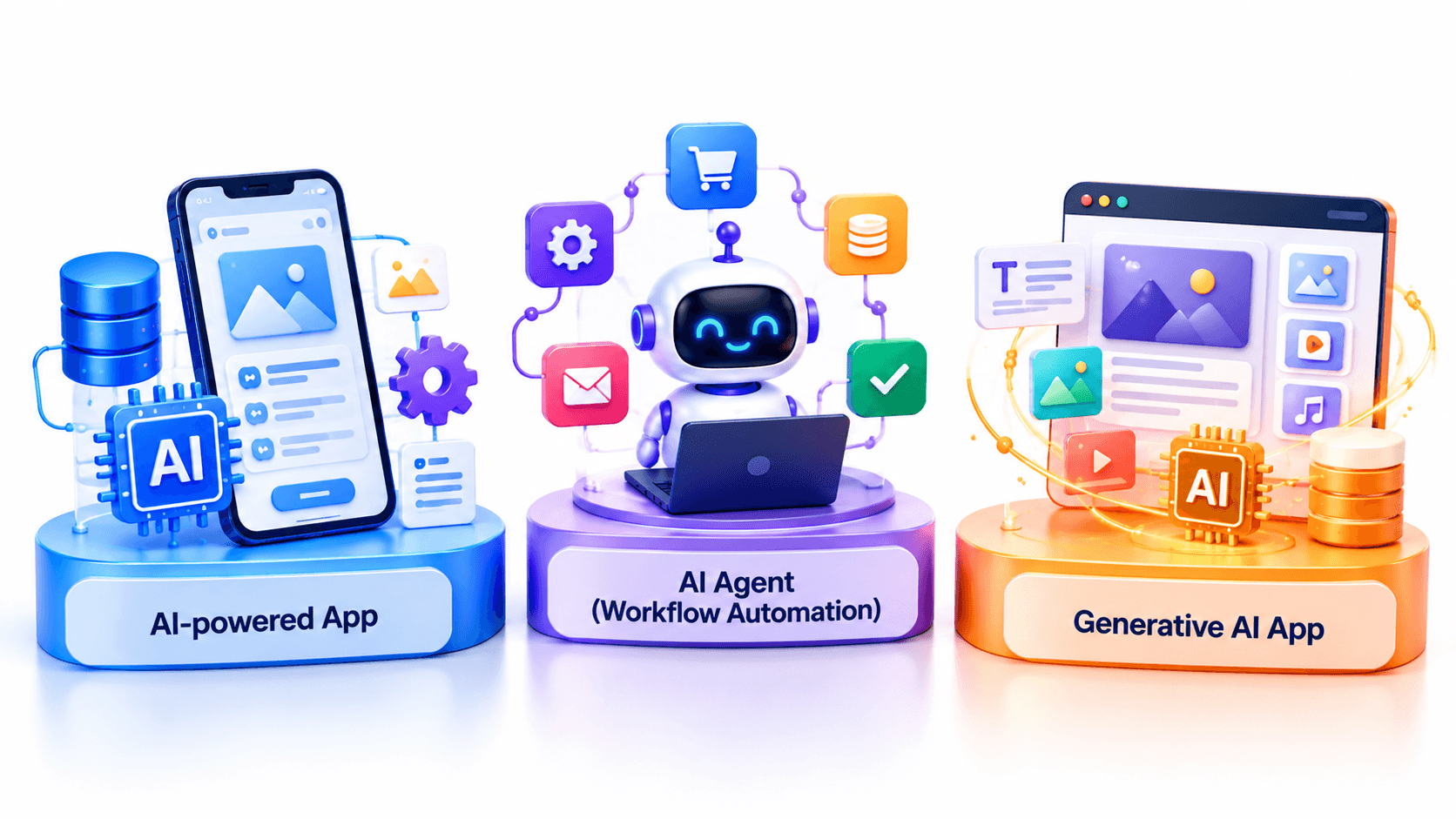
These three get lumped together. They cost differently because the expensive part sits in a different place for each. Traditional AI-powered app. Most of the budget goes into data prep, model integration, and app design. This guide covers it in full.
- AI agent or workflow automation - The money goes into tool integrations, guardrails, and testing many decision paths. See the full AI agent development cost breakdown.
- Generative AI app - Token usage, retrieval setup, and output evaluation drive the bill. Our guide to generative AI build costs covers the details.
- A support bot shows the difference well - A basic AI chatbot development cost covers answering questions. Turn that bot into an agent that issues refunds and updates orders, and you’re paying for integrations, guardrails, and far more testing.
Cost by Region: India vs USA vs Eastern Europe
Location is the fastest way to change your budget without changing your scope. This table prices the same mid-tier app at 1,800 hours, using agency blended rates from Shimira IT’s 2026 benchmark.
| Region | Typical agency rate | Mid-tier app (1,800 hours) |
|---|---|---|
| USA | $150 to $250 | $270K to $450K |
| Eastern Europe | $50 to $100 | $90K to $180K |
| India | $25 to $60 | $45K to $108K |
Same app, same hours. The only variable is the rate, which is why AI development cost comparisons that ignore location tell you very little.
When you compare AI software development pricing across regions, check what’s included. A low rate without a project manager, QA, or overlap with US working hours often costs more in rework.
Running Costs Nobody Puts in the Quote
Here’s what nobody mentions on the sales call. The build is a one-time bill, but running the app is a monthly one. That makes the build only part of your AI app development cost. For AI apps, the monthly part grows with every user.
Cloud Hosting and Infrastructure
This covers servers, databases, vector storage for retrieval, and monitoring tools. For a mid-tier app with moderate traffic, we assume a few hundred to a couple of thousand dollars a month. Your actual bill depends on traffic and cloud provider.
Model API Usage
This is the cost that surprises people. Every time a user asks your app something, you pay the model provider per token. Here’s a simple example with the assumptions stated:
- The app has 5,000 monthly active users, each making 20 AI requests a month. That’s 100,000 requests.
- Each request uses 1,500 input tokens and 500 output tokens.
- Pricing is $2 per million input tokens and $10 per million output tokens, the October 2026 rate for mid-tier models (BenchLM, IntuitionLabs).
That works out to $300 for input plus $500 for output, about $800 a month. Grow to 50,000 users and the same app costs about $8,000 a month to run.
Model choice moves this number more than anything else. Budget models priced around $0.10 input and $0.50 output per million tokens, per the same sources, would handle the 5,000-user workload for roughly $40 a month. Routing simple requests to cheaper models is one of the easiest savings you’ll find.
Maintenance, Monitoring, and Updates
Models drift, providers retire model versions, and users find edge cases. Industry practice is to budget 15% to 25% of the original build cost per year for support and maintenance.
That’s your real AI app maintenance cost, and it never drops to zero.
18-Month Total Cost Example
Let’s put the full AI app development cost together for one mid-tier app built offshore. The example is a customer-facing web app with retrieval over company documents and three integrations.
| Cost item | Assumption | Source | 18-month cost |
|---|---|---|---|
| Build | 1,800 hours at a $40 blended rate | RemoteState estimate, Clutch rate range | $72,000 |
| Cloud hosting | $800 a month | RemoteState assumption | $14,400 |
| Model API usage | $800 a month | Worked example above | $14,400 |
| Maintenance and monitoring | 20% of build per year | Midpoint of the 15% to 25% industry range | $21,600 |
| Total | $122,400 |
Look at the split. Running costs make up about 41% of the 18-month total.
Any AI software development cost estimate that shows only the build number is showing you a little over half the picture.
How to Lower the Cost Without Losing Quality
- Start with a focused MVP - A realistic AI MVP development cost is a fraction of a full build, and it shows you what’s worth building next.
- Use existing models and APIs first - Consider fine-tuning only when you can prove prompting and retrieval fall short.
- Rank features by business value - Cut the bottom third from version one and add them once real usage justifies them.
- Lock integration and performance requirements early - Scope changes in the middle of a build are the most expensive kind.
- Track token usage from week one - Set alerts and route simple requests to cheaper models.
How We Estimate AI Projects
Every hour range in this guide comes from the same method we use when scoping client work. We check four AI app development cost factors before quoting anything.
- Data Readiness - Is your data clean, accessible, and legally usable? Messy data is the most common reason an estimate grows.
- Model Approach - Can prompting with retrieval reach the accuracy you need, or does the task require fine-tuning?
- Integration Count - How many systems does the app read from or write to?
- Usage Forecast - How many users and requests do you expect in the first 12 months? This number decides your running costs.
Only after these four are clear do we put hours against features. Any AI project cost given before that is a guess.
Is AI App Development Worth the Investment?
Run a simple test. Estimate the monthly value the app creates in hours saved, revenue added, or support tickets avoided. Then compare it with the monthly running cost plus the build cost spread over 18 months.
If the value doesn’t clearly beat the cost in that window, shrink the scope until it does. The cost to build an AI app should be judged against what it pays back, not against what a competitor spent.
If you’ve read this far, you probably have a rough tier in mind. The next question is who builds it, and whether they can show you the math before you sign anything.
How RemoteState Builds AI Apps

RemoteState builds AI apps with engineering in Noida, India, and accountability through our US office in Santa Monica, CA. Our Clutch-verified rates run $25 to $49 an hour, well below the $150 to $250 typical of US agencies.
Before you compare AI development company pricing, ask every vendor to show hours per feature. We do that by default.
One example is a US chronic-care AI app. Our three-person team, one backend developer, one DevOps specialist, and one AI/ML engineer, spent 10 months building computer vision for pill identification, vitals readings from selfies, and a HIPAA-compliant backend on AWS with Kubernetes.
The hardest requirement wasn't the AI. Every patient image and health reading had to be encrypted, logged, auditable, and deletable on request. That's why the HIPAA architecture was decided in week one, before any model work started, and why a dedicated DevOps engineer sat on a team of three.
The vision model also had to work on real phone photos, not lab images. It reached over 95% pill recognition accuracy across variable lighting. That's the kind of accuracy target that decides how much data collection and testing a project needs.
The app passed 50,000 downloads in its first year without paid acquisition and drove 250% revenue growth. Read the full case study.
Final Thoughts
AI app development cost isn’t one number. It’s the build, plus 18 months of running the app, weighed against the value it creates. The cheapest AI app cost upfront is rarely the cheapest app to own.
If you want that math done for your idea, talk to our AI development team for a free AI app development cost estimate. We’ll show you the hours behind it, not just the total.
Frequently Asked Questions
Got two wildly different quotes for the same AI app? Both can be right. Here’s what really drives AI app development cost in 2026, and what to budget for.


