
Hiring offshore developers sounds straightforward until you've done it once and gotten burned.
You find someone with a great profile, reasonable rates, and confident replies during the interview. Three months later, you're sitting on half-built features, missed deadlines, and a codebase nobody else wants to touch. Sound familiar? It happens more than most founders admit.
The good news is that this isn't an offshore problem. It's a process problem. When you hire offshore developers the right way, with the right structure and the right partner, you get a team that genuinely moves your product forward. This guide walks you through exactly how to do that.
What Does It Mean to Hire Offshore Developers?
Offshore development means building your engineering team in a country other than where your business is based. That could be India, Eastern Europe, Southeast Asia, or Latin America. The geography changes. The principle stays the same.
You're not outsourcing a project and hoping for the best. You're hiring real engineers who work within your systems, follow your processes, and contribute to your product the way any in-house developer would. The distinction matters because it changes how you hire, how you onboard, and how you manage.
Think of it less like delegating work and more like opening a second engineering office, just a few time zones away. That's what it really means to hire offshore developers with intention.
Why Companies Choose Offshore Development Teams
Cost is the obvious answer, but it's rarely the only one. A mid-level software engineer in the US runs anywhere from $110,000 to $160,000 a year in base salary alone. That same experience level in India or Southeast Asia costs significantly less without any compromise on output quality. For a startup trying to stretch runway, that math changes everything. Beyond cost, here's what actually drives the decision for most businesses:
Talent availability - Certain skills are genuinely hard to find locally. Offshore markets often have deep talent pools in backend engineering, DevOps, and QA.
Speed of hiring - A proper offshore partner can get you vetted developers in two to three weeks. Local hiring often takes three to five months.
Flexibility - You can scale your team up or down based on what your product roadmap actually demands.
Continuous delivery - With the right time zone overlap, your product can move forward while your local team sleeps.
For companies operating across regions or building complex platforms, choosing to hire an offshore development team isn't just cost optimization. It's a competitive advantage.
How to Hire Offshore Software Developers Step by Step
Understanding how to hire offshore software developers isn't just about finding profiles online. It's about building a repeatable process that filters for quality at every stage.
Define Your Project Requirements First
Before you talk to a single developer or agency, write down exactly what you need. What tech stack? What seniority? What does the first 60 days of work look like? Vague briefs attract vague candidates. The more specific you are upfront, the faster everything moves.
Choose the Right Hiring Model
You have three real options. A dedicated offshore development team works best for ongoing product development where you need continuity and ownership. Staff augmentation plugs skilled engineers into your existing team for specific capacity needs. Project-based hiring works for clearly scoped, time-limited builds. Pick based on your actual situation, not what sounds cheapest.
Evaluate Technical Depth, Not Just Credentials
Resumes and portfolios tell you part of the story. A real technical assessment tells you the rest. Give candidates a task that mirrors your actual work. Have someone on your team review the output critically. You're not looking for perfection. You're looking for how they think and how they handle problems.
Test Communication Before You Commit
Bad communication kills offshore engagements faster than bad code. Run a proper video call. Ask candidates to walk you through a technical decision they made recently. Pay attention to clarity, not just fluency. Someone who asks smart questions and admits what they don't know is worth more than someone who sounds confident about everything.
Verify the Work, Not Just the Words
Ask for GitHub links, previous client references, and examples of systems they've shipped. If they've worked in your industry before, that's worth more than any certification. Call the references directly. Ask hard questions about reliability, communication, and how they handled pressure.
Start With a Paid Trial
Before any long-term contract, run a small scoped engagement. Pay them for it. This gives you real signal on quality, communication, and work ethic without a major commitment. Most strong candidates welcome it. The ones who resist it tell you something important.
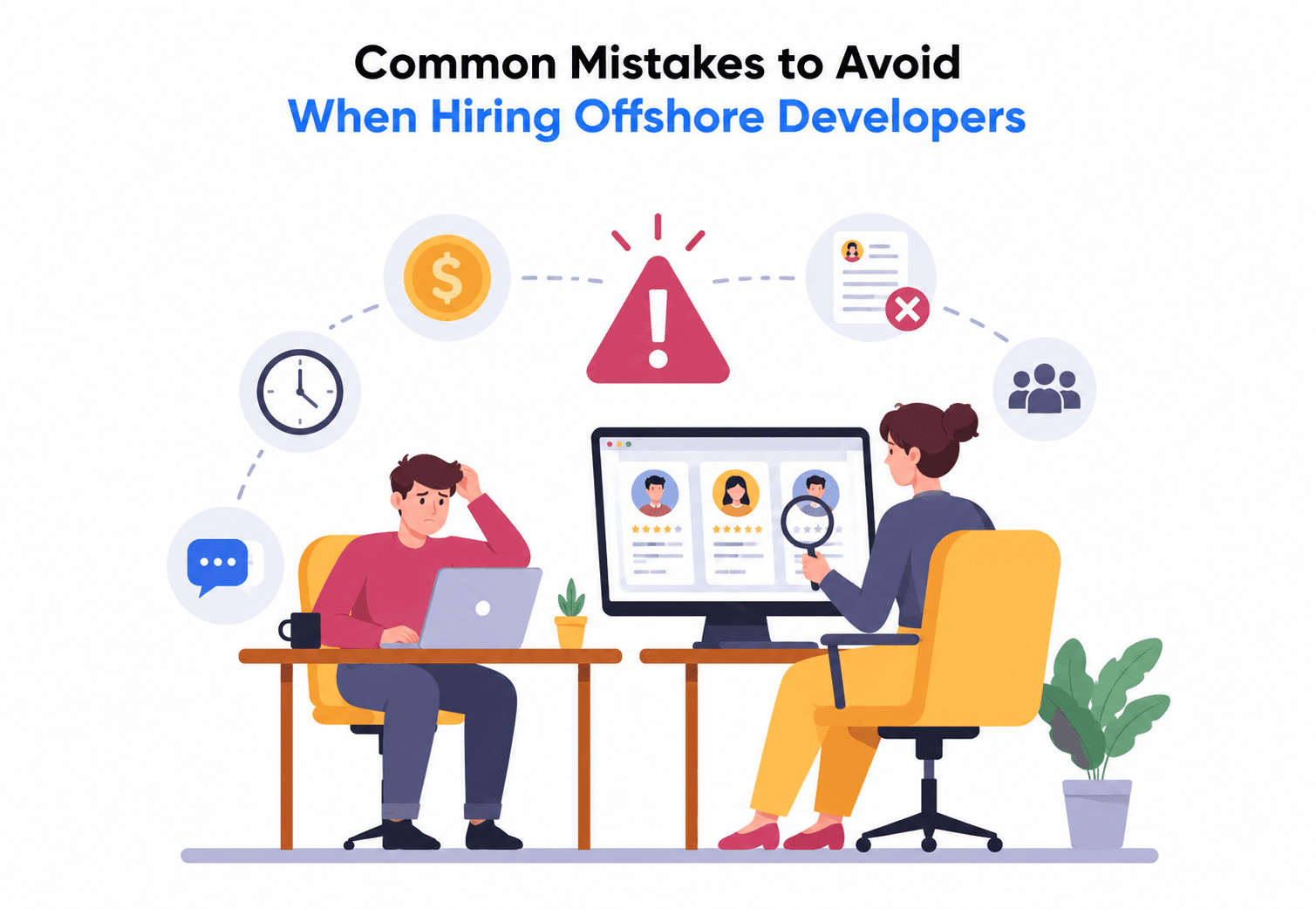
Common Mistakes to Avoid When Hiring Offshore Developers
These aren't edge cases. They're patterns that repeat constantly.
Choosing on price alone
The cheapest developer almost always creates the most expensive problems. Pay fair rates for the talent level you actually need.
Skipping proper onboarding
Remote doesn't mean self-sufficient from day one. Invest real time in getting offshore developers familiar with your product, your codebase, and your team.
Not defining what success looks like
If you don't set clear metrics and expectations, you'll spend months disagreeing about whether things are going well.
Ignoring time zone overlap
You need at least three to four hours of shared working time daily for real collaboration to happen. Plan this in advance.
Keeping them at arm's length
Offshore developers who feel like vendors deliver like vendors. The ones who feel like team members deliver like team members.
When Should You Hire an Offshore Development Team Instead of Freelancers?
Freelancers are great for isolated, well-defined tasks. A landing page. A single API integration. A bug fix sprint. When the work is contained, freelancers make sense. The moment you're building something that requires continuity, architecture decisions, cross-functional collaboration, or long-term ownership, you need to hire an offshore development team instead. A freelancer won't remember what decisions were made six months ago. A dedicated team will. That institutional knowledge is what actually lets you ship faster over time.
What to Look for in an Offshore Software Development Company
If you're going through an offshore software development company rather than hiring directly, the quality of their vetting process is everything. You're trusting them to filter out the noise before it reaches you. Here's what separates the good offshore software development services from the rest:
1. A structured, documented process for how they hire and vet developers
2. Transparent pricing with no surprises buried in the contract
3. Actual case studies from companies at your stage or in your industry
4. A point of contact who understands your business, not just your ticket queue
5. References you can call without being coached on what to say
The range of quality across offshore software development services is wider than most people expect. The differentiator is almost always process and accountability. Ask hard questions before you sign anything.
How RemoteState Helps Businesses Build Offshore Development Teams
RemoteState was built specifically for companies that need offshore software development services that function like real engineering units, not black-box vendors you check in with once a week.
The process starts with understanding your product, your stack, and how your team actually works. From there, RemoteState handles sourcing, technical vetting, and cultural fit before you meet a single candidate. You only spend time with people who are ready to contribute.
Once onboarded, your team integrates into your existing workflow. Your Slack, your sprints, your standups. RemoteState manages the operational layer: payroll, HR, compliance, and everything else that slows down direct offshore hiring. You stay focused on the product. That's the difference a structured offshore software development company makes when the process is built right.
RemoteState’s Client Success Story
The Challenge
A large financial services company operating across Southeast Asia was running insurance operations in Cambodia, the Philippines, Myanmar, and Laos simultaneously. They needed to modernize core backend systems, execute cloud migrations, maintain platform stability, and keep pace with rapidly changing regional insurance regulations, all at the same time. Local hiring couldn't move fast enough. Internal teams were stretched thin. The gap between what the business needed and what engineering could deliver was widening every quarter.
The Solution
RemoteState stepped in with a 20-person dedicated offshore development team built specifically around the engagement's needs: - 6 full-stack engineers - 5 backend engineers - 4 QA engineers - 5 DevOps engineers. The team was deployed across multiple regions and integrated directly into the client's existing operational structure. The first wave focused on codebase modernization, DevOps pipeline setup, and knowledge transfer. As the engagement matured over 18 months, the team expanded its scope to cover release management, compliance support, QA automation, solution architecture reviews, and live customer support operations.
Results
Before RemoteState, the platform release cycle was slow and constantly bottlenecked by limited QA and DevOps capacity. After the engagement, here's what changed:
Platform Release Cycle - Went from slow, bottlenecked releases to a fully streamlined pipeline with automated QA and a dedicated DevOps process the team built and owned end to end.
Engineering Coverage - Expanded from a single region with limited bandwidth to full multi-country coverage across four Southeast Asian markets without adding operational chaos.
Operational Overhead - Dropped significantly. Internal teams were consistently overloaded before the engagement. The structured offshore delivery model absorbed that pressure and gave leadership more room to focus on strategy.
Time to Onboard Engineers - Went from months due to regional hiring constraints down to weeks. That speed made a real difference every time the business needed to respond to shifting priorities.
Digital Growth Capacity - Fully unlocked. The company couldn't pursue new initiatives before because existing systems demanded too much attention. By the end of the 18-month engagement, they had the engineering foundation and bandwidth to launch new digital insurance products across the region at scale.
The VP overseeing the engagement said it plainly: RemoteState's engineers onboarded quickly, mastered the domain, and delivered high-quality solutions plus process improvements throughout a complex, cross-border engagement.Want to see the complete project breakdown and strategy? [Read the full case study here](/about/case-studies/scaling-insurance-operations-with-engineering).
Frequently Asked Questions
How much does it cost to hire offshore developers?
Rates depend on the region, seniority level, and engagement model. Developers in India and Southeast Asia typically range from $25 to $55 per hour. Eastern European developers range from $40 to $75 per hour. Either way, the savings compared to equivalent US talent are significant, often 50 to 70 percent.
How do I manage communication with an offshore development team?
Structure it from day one. Define async communication norms, set up shared tools like Slack, Jira, or Notion, and schedule recurring video syncs during overlapping hours. Communication doesn't fail because of time zones. It fails because nobody designed the system properly upfront.
Are offshore developers actually as good as local developers?
Yes, when you hire correctly. Countries like India, Ukraine, and the Philippines produce genuinely world-class engineers. The quality of your hiring process determines the quality of your team, not the country of origin.
When does it make sense to use offshore software development services versus building a team directly?
If you don't have the internal capacity to source, vet, onboard, and manage remote engineers, a partner like RemoteState removes that burden entirely. Building directly works if you have strong offshore hiring experience already. Most companies don't.
How long does it take to build an offshore development team?
With the right partner, two to three weeks for an initial team. Going direct typically takes two to four months when you factor in sourcing, interviews, assessments, offers, and onboarding. Speed matters when you have a roadmap to hit.
Conclusion
Hiring offshore developers works. Companies do it successfully every day to build real products, ship faster, and scale without burning through budget. But it only works when you treat it like a real hiring decision, not a shortcut. Define what you need. Vet seriously. Onboard properly. Build a team culture that includes your offshore engineers, not one that separates them. And if you're not sure how to run that process well, work with a partner who already has. If you're ready to hire an offshore development team that actually delivers, RemoteState is a good place to start.
Hire Dedicated Offshore Developers to access top global talent, reduce development costs & speed up project delivery. Build your remote team with us!


