
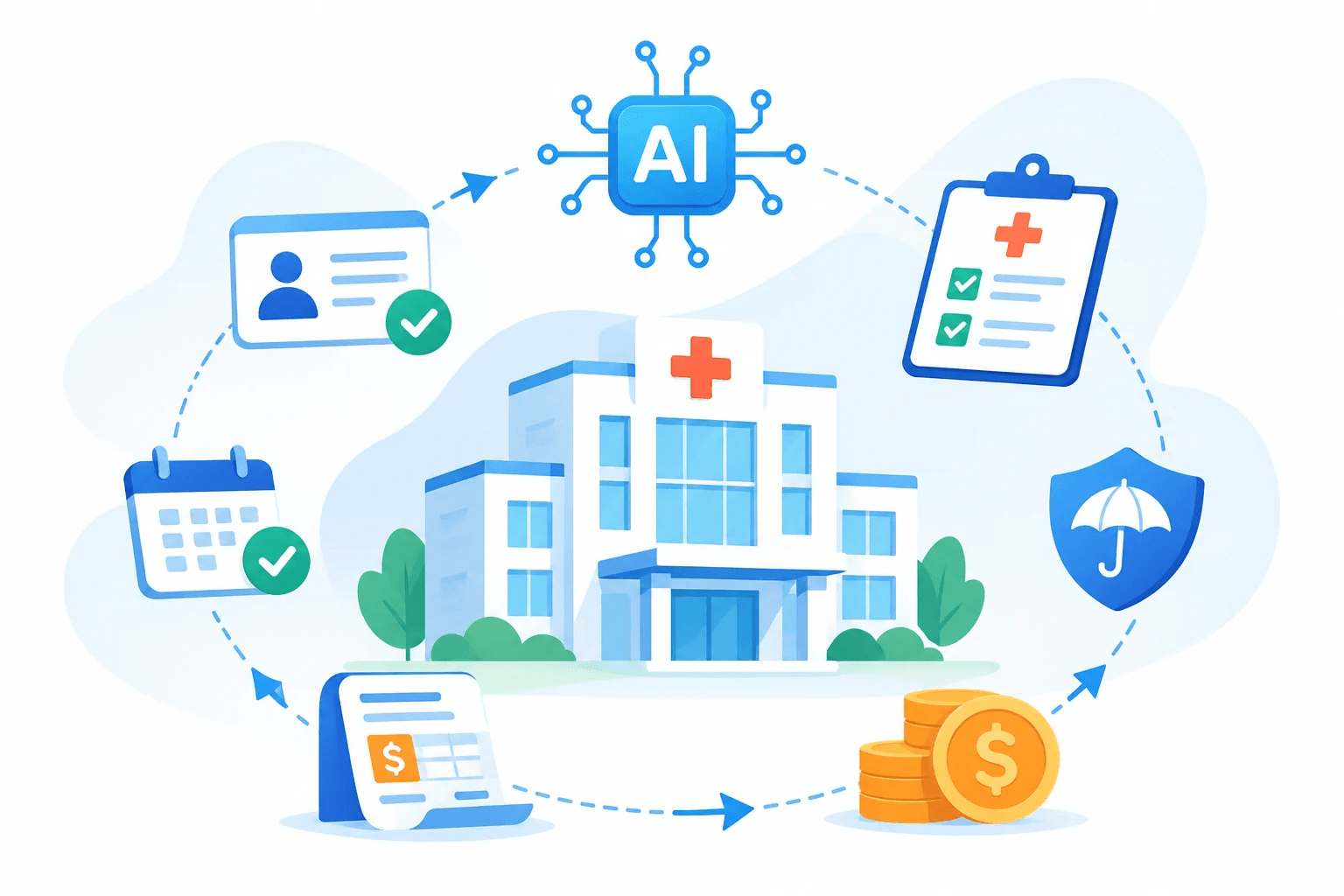
A claim goes out. Weeks later it comes back denied for a missing authorization, a coding mismatch, or an eligibility detail nobody caught at registration. Someone on the billing team starts over.
That loop is the daily reality of revenue cycle management (RCM), the process that runs from patient registration and insurance checks through coding, billing, claims, and final payment. It’s also where AI in revenue cycle management is starting to earn its place.
This guide walks through where AI helps at each stage of the revenue cycle, what it takes to build, and where a human still needs to stay in the loop.
What Does AI Do in RCM?
AI in revenue cycle management means using machine learning, natural language processing, and predictive models to handle the judgment-heavy parts of healthcare billing. It reads documentation, checks claims for errors before submission, and flags accounts likely to be denied or paid late.
Automation vs. AI: Not the Same Thing
Most RCM teams already use rules-based automation. Bots log into payer portals, copy data between systems, and follow fixed steps. That’s useful, but it breaks the moment a form or rule changes.
AI handles what rules can’t: reading a physician’s note, spotting a pattern across thousands of denials, or deciding which claims need a second look. The strongest healthcare revenue cycle automation setups combine both, with rules for the predictable steps and AI for the judgment calls.
Traditional vs. AI-Assisted RCM
| Task | Traditional approach | AI-assisted approach |
|---|---|---|
| Eligibility checks | Staff check portals or call payers | Automated checks before the visit, with exceptions flagged |
| Coding | Coders read every chart from scratch | AI suggests codes, coders confirm |
| Claim review | Errors found after rejection | Errors flagged before submission |
| Denials | Worked one at a time, after the fact | Patterns spotted, high-risk claims caught early |
AI Use Cases Across the Revenue Cycle
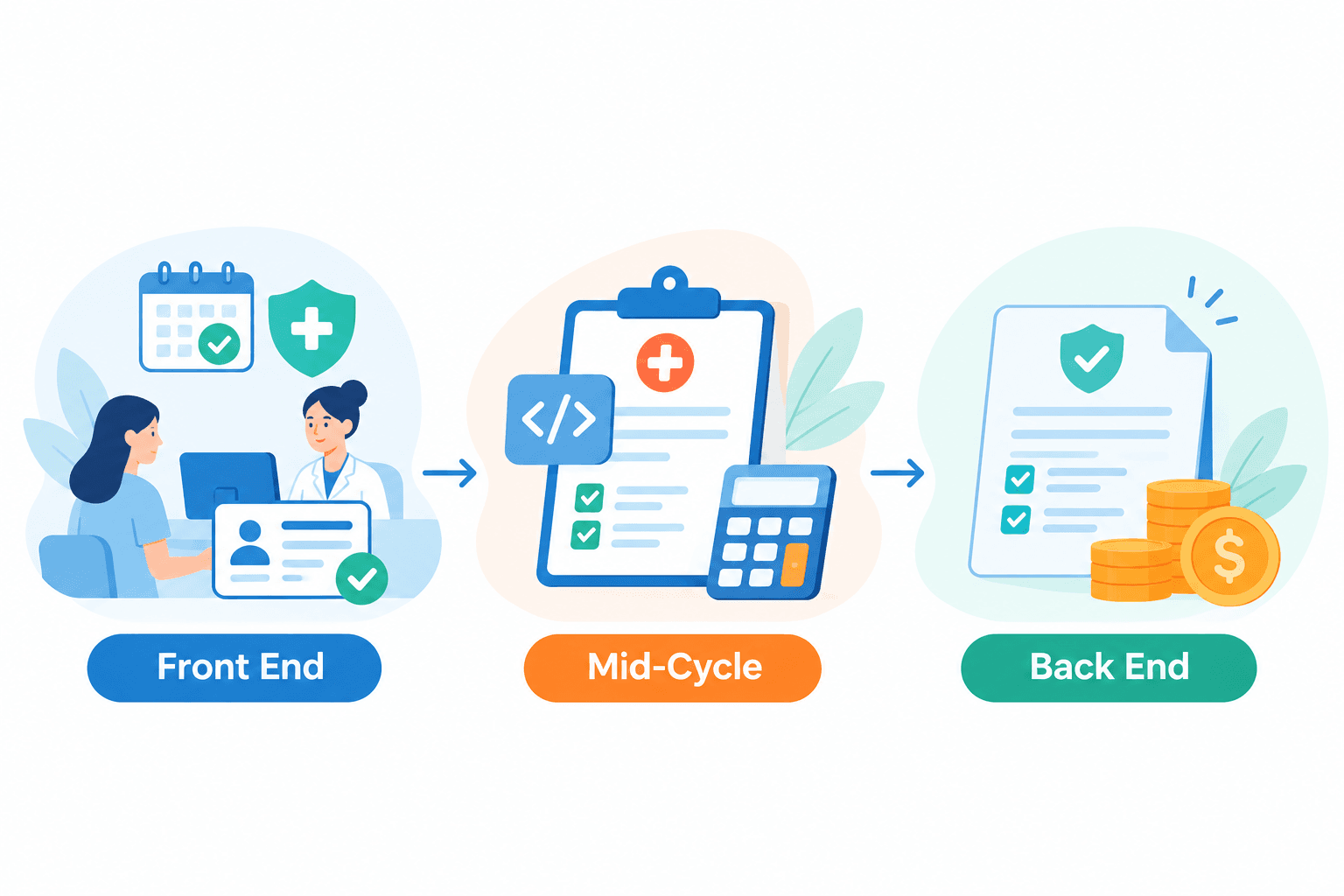
The clearest way to see where AI fits is to follow a claim from start to finish. Each use case below covers what AI does and where a person still needs to decide.
Front End: Before the Patient Is Seen
Insurance eligibility and verification
Many denials trace back to registration: an inactive policy, a wrong member ID, or a plan that doesn’t cover the service. AI insurance verification tools run eligibility checks before the visit, compare results against scheduled services, and flag mismatches.
Human in the loop: Staff handle the exceptions, such as coordination of benefits questions and conflicting coverage.
Prior authorization
Prior authorization is one of the most manual steps in healthcare. Prior authorization automation gathers the required clinical documentation, checks payer requirements, and tracks requests. AI prior authorization tools can also predict which services will need approval at all.
Timing makes this urgent. Under the CMS Interoperability and Prior Authorization Final Rule, affected payers, including Medicare Advantage, Medicaid, CHIP, and federal exchange plans, must support FHIR-based prior authorization APIs by January 1, 2027. Systems built to use those APIs will be able to replace much of today’s fax and portal work.
Human in the loop: Clinical staff review anything that involves a medical necessity judgment.
Mid-Cycle: Turning Care Into Codes
Medical coding
AI medical coding tools read clinical documentation using natural language processing and suggest diagnosis and procedure codes. They also flag missing documentation that would make a code hard to defend.
Human in the loop: Certified coders confirm every suggested code. AI speeds up the work, but accountability for what gets billed stays with people.
Billing and charge capture
Missed charges are lost revenue nobody notices. AI in medical billing compares documentation against billed charges to catch services that were performed but never billed, and scrubs claims for errors before they go out. Many automated medical billing software products now include these checks. The question for most teams is whether those built-in checks fit their specialties and payers, or whether they need something custom.
Human in the loop: Billing staff review flagged discrepancies before charges are added or changed.
Back End: Getting Paid
Claims processing
AI claims processing extracts data from documents, validates it against payer rules, and catches errors before submission. Healthcare claims automation then handles routing, status checks, and follow-up.
Most medical claims management software already handles the workflow itself. AI adds the layer that predicts which claims are likely to fail, and why.
Human in the loop: Staff decide how to fix flagged claims, especially when payer rules conflict.
Denial prediction and management
Denials are where revenue quietly leaks. AI denial management tools score claims for denial risk before submission, group past denials by root cause, and help teams decide which appeals are worth pursuing.
Here’s what nobody mentions: the biggest gain usually isn’t winning more appeals. It’s finding the upstream problem, like a registration habit or a documentation gap, that keeps causing the same denial.
Human in the loop: Appeals still need people who understand the payer, the contract, and the clinical context.
What It Takes to Build AI for RCM
Vendors rarely talk about this part, but anyone building AI for the revenue cycle runs into it quickly. The model is the easy piece. Connecting it to healthcare’s data standards and systems is the real work.
The data standards you’ll work with
Clinical data usually moves through HL7 messages or FHIR APIs. Financial transactions run on X12 standards, each with its own job:
- 270/271: eligibility inquiry and response
- 276/277: claim status inquiry and response
- 278: prior authorization requests and responses
- 837: claim submission
- 835: payment and remittance advice
An AI model that predicts denials, for example, needs 837 claim data and 835 remittance data matched correctly. That matching is often harder than the prediction itself.
The systems AI has to connect to
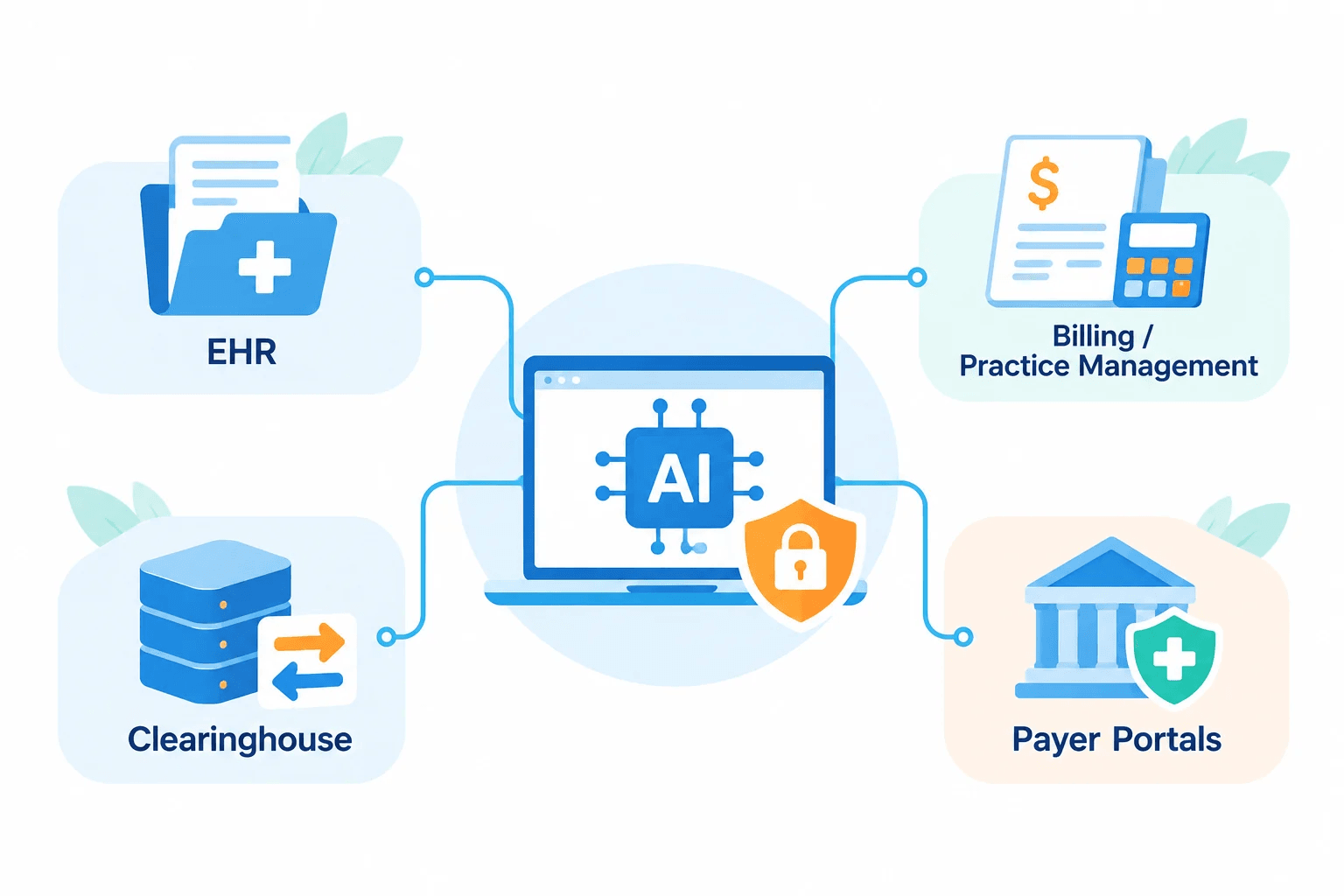
A typical stack includes the EHR, a practice management or billing system, a clearinghouse, and payer portals. Each has its own data formats, access rules, and limits on what outside software can do.
PHI runs through all of it. Any partner touching that data needs a business associate agreement, access logging, and clear rules about where data goes, including keeping PHI out of third-party AI services that haven’t been vetted for it.
Building AI into your RCM stack? Talk to our healthcare engineering team.
The Benefits, Briefly
When AI is applied to the right workflows, teams typically see four kinds of improvement:
- Less manual work on eligibility checks, status checks, and data entry
- Errors caught before submission instead of after rejection
- Clearer visibility into why denials happen
- Staff time shifted from repetitive tasks to complex accounts
The size of the gain depends on your data, your payer mix, and how well the tools fit your workflows. Be wary of anyone who promises a fixed improvement before they’ve seen your data.
Challenges of Bringing AI Into RCM
Data quality and EHR integration
AI learns from your data. Incomplete records, inconsistent coding history, and disconnected systems produce unreliable suggestions, however good the model is.
HIPAA and patient data security
Every AI workflow that touches PHI needs HIPAA-aligned access controls, audit logs, and signed vendor agreements. Security review should start on day one, not right before launch.
Accuracy, oversight, and audit risk
Payers audit. If AI medical coding suggestions push codes higher than the documentation supports, the healthcare organization carries the compliance risk, not the software vendor. Human review and clear audit trails aren’t optional.
Cost and workflow adoption
Integration, training, and change management often cost more than the AI itself. Staff who don’t trust the suggestions will find ways to work around them.
Build, Buy, or Integrate: How We Evaluate the Options
There are three ways to bring AI into your revenue cycle, and buying a platform is sometimes the right answer.
| Option | Best when | Trade-off |
|---|---|---|
| Buy a platform | Your workflows are standard and your EHR is well supported | Less flexibility and ongoing licensing costs |
| Integrate AI into your stack | Your systems work, but specific steps need AI | Requires real integration expertise |
| Build custom | You’re a healthtech company, or your workflows are unusual | Highest upfront effort, full ownership |
For healthtech companies and provider groups with custom systems, integrating or building usually wins. Off-the-shelf healthcare revenue cycle automation rarely fits unusual payer mixes or specialty workflows. That’s where custom healthcare software development makes sense.
Whichever path you choose, we evaluate it on four criteria.
EHR, billing, and clearinghouse compatibility: Can it read from and write to the systems you already use, in the formats they support?
Audit trails and explainability: Can you see why the AI made each suggestion? Auditors and payers will ask.
Human review and exception handling: Does it send uncertain cases to people, or push everything through automatically?
HIPAA posture: Will the vendor or partner sign a BAA, and can they show exactly how PHI is protected? The same standard applies to any tool for AI in medical billing, coding, or claims.
Getting Started
Start with one workflow and one high-volume payer. AI claims processing for a single payer, for example, gives you a clear baseline and fast feedback.
From there, assess your data, run a pilot with defined success metrics, and scale only after accuracy holds up. Our AI implementation roadmap covers each phase in detail.
RemoteState Builds Healthcare AI
A plan only matters if the team building it understands healthcare’s systems and its rules. That’s the experience we bring, and we’ll be clear about its scope.
haven’t built an RCM platform. What we have built is AI that works inside clinical systems, with the integration and PHI discipline that RCM work demands.
For a healthcare provider, our team built a voice-activated clinical assistant with speech-to-text, EMR integration, and prescription automation using OpenAI. It also included a scheduler that purges data on a set timeline, the kind of PHI retention control every RCM system needs. A team of three delivered it in seven months.
For a US prescription refill platform, we integrated with major pharmacy chains’ systems and added AI scheduling and clinical report management. Connecting to outside healthcare networks like these is the same kind of work as connecting to clearinghouses and payers.
Engineering runs from Noida, India, and our Santa Monica office handles accountability for US clients. For integration-heavy projects, we provide engineers who embed with your team and work inside your systems. You can explore our healthcare case studies for more detail.
Conclusion
AI in revenue cycle management works best when it’s applied narrowly: verifying coverage, suggesting codes, catching claim errors, and spotting denial patterns, with people still making the final calls.
If you’re planning to build or integrate AI into your RCM workflows, talk to the RemoteState team.
Frequently Asked Questions
Most RCM vendors promise AI will fix denials. Here’s where AI actually helps in billing, coding, and claims, and where it still needs a human in the loop.


