
I'll be straight with you. Most healthcare CRM guides throw out a single number and call it done. That number alone doesn't tell you much. I've seen two projects both labeled "healthcare CRM" land $200,000 apart with what looked, on paper, like nearly the same feature list.
The real driver of healthcare CRM software development cost has almost nothing to do with the CRM label. It's whether the system touches protected health information, how deep it has to sync with your EHR, and whether front-desk staff can actually use it without a week of training first.
What Healthcare CRM Software Development Actually Costs in 2026
Here's the breakdown, without the vague single figure most guides lead with.
Basic MVP: $30,000 to $80,000. Contact management, scheduling, basic reminders. Barely any EHR sync, if any.
Mid-complexity: $80,000 to $300,000. Multi-channel messaging, referral tracking, FHIR or HL7 integration with your EHR, proper role-based access.
Enterprise: $300,000 to $600,000+. Multi-entity rollouts, predictive analytics, AI-driven outreach, several systems wired together at once.
Once you're past that mid tier and syncing four or five systems across multiple facilities, honestly, the number stops being predictable. It comes down to your specific stack more than any pricing formula anyone can hand you upfront.
When You Shouldn't Build a Custom CRM
I'd rather tell you this now than sell you something you don't need.
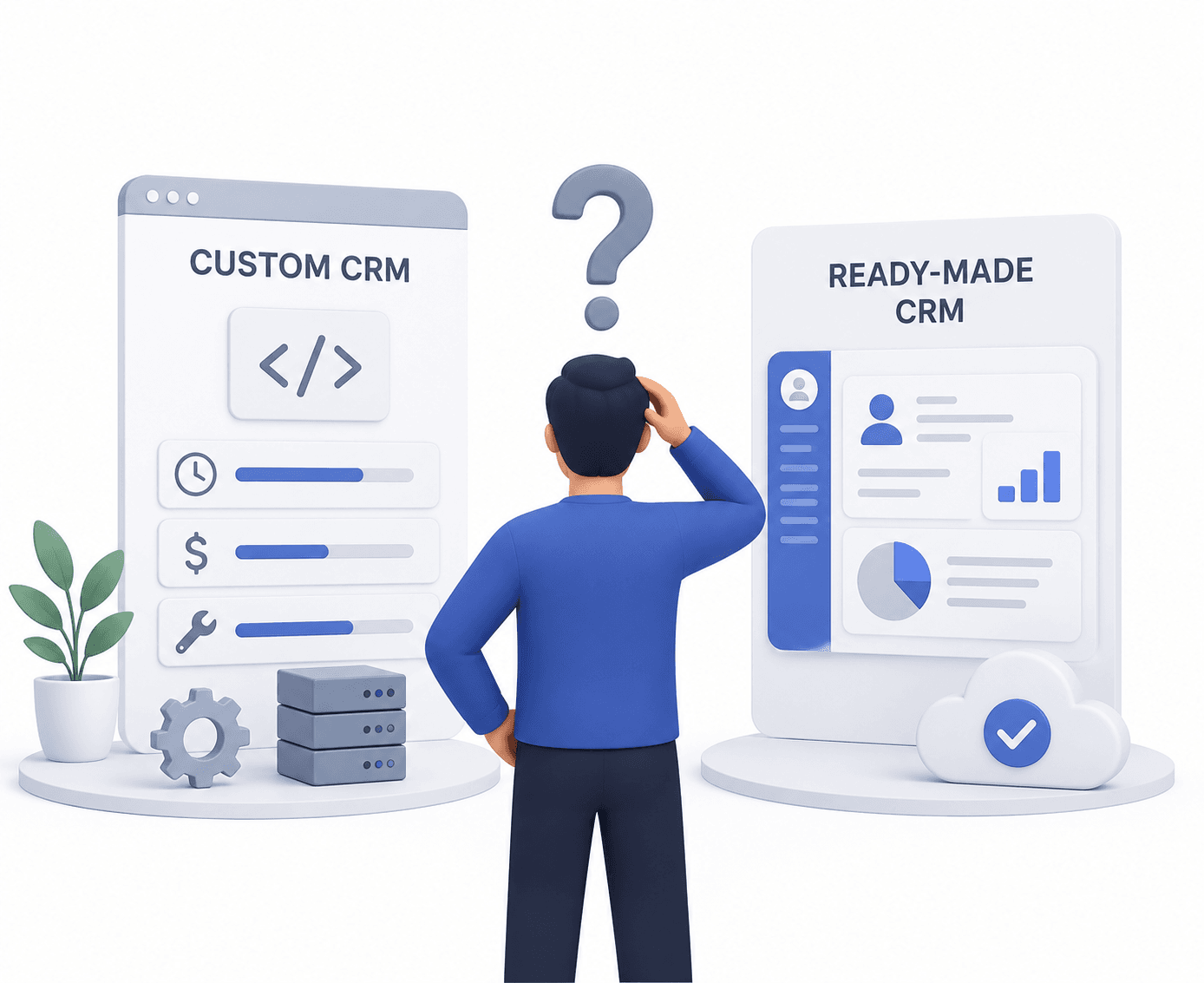
Under 10 users, under 500 patients a month, or you just need basic scheduling without deep EHR logic? Skip custom. The build cost and the months-long timeline won't pay themselves back at that scale, and that's just math, not opinion.
A configured off-the-shelf tool gets you live in weeks. Custom only starts winning once your workflows get complicated enough, or your volume is high enough, that a generic system starts working against you instead of for you.
Buy vs. Build: Salesforce Health Cloud vs. Custom CRM
This is the comparison most guides skip, and honestly it's usually the first real decision on the table.
Salesforce Health Cloud
Upfront cost is low, roughly $50,000 to $100,000 for implementation. The catch is the ongoing bill, around $300 per user every month, which stacks up fast once you've got any real headcount. Out of the box, it's generic, so you're the one bending to fit it. Good fit if you're under 10 users and need something live in weeks.
Custom Healthcare CRM
Upfront cost swings from $30,000 up to $600,000 depending on tier. After launch you're mostly paying maintenance, usually 15 to 20 percent of build cost a year. What you get back is a system shaped around how your team actually works, not the other way around. Makes more sense once you're past 10 users or your workflows stop being simple.
Do the math before picking a side. A 15-person practice on Salesforce Health Cloud lands near $54,000 a year, which crosses $160,000 over three years before a single custom feature gets added. Past that headcount, custom healthcare CRM software development services tend to win on total cost, not just on capability.
What You're Actually Paying For
Four things move the price more than anything on a feature list.
Integration Depth - Connecting one EHR is nothing like connecting EHR, billing, and telehealth all at once. Every new connection adds testing and ongoing upkeep that never shows up in the first quote you get.
Compliance Architecture - The second a patient's name sits next to an appointment date, that pairing is PHI. Encryption, audit logs, access controls, signed BAAs with every vendor touching that data chain. All of it.
Customization Level - Light configuration on an off-the-shelf tool ships fast. A fully custom healthcare CRM development build matches your real workflows, but design and build both take longer, no shortcut around that.
Team and Deployment Model - Cloud deployment cuts infrastructure spend by a lot. Where your dev team physically sits changes the final number more than most people expect walking in.
Cost by Region: India vs. USA
Location alone is one of the biggest levers on this whole list, and it's the one people underweight most.
US agencies typically run $100 to $250 an hour for healthcare work, which pushes even a mid-complexity build well past $300,000 before integrations are even finished. India-based teams with real healthcare compliance experience run $25 to $60 an hour instead, cutting total cost by something like 40 to 60 percent for comparable work.
Here's the catch though. Cheaper doesn't automatically mean capable. HIPAA and FHIR knowledge isn't universal at any price point, so those savings only hold up if the team actually understands healthcare compliance walking in, not figuring it out on your project's clock.
CRM Software for Healthcare vs. EHR
Two different jobs, even though people mix them up constantly.
CRM software for healthcare handles the relationship side. Outreach, scheduling, communication history, referrals. The EHR handles the clinical record, diagnoses, treatment history, lab results, the stuff that needs to stay locked down and auditable.
Most projects that go sideways are trying to make one system do both jobs at once. The ones that actually work keep EHR as the single source of clinical truth and let the CRM run everything patient-facing, synced through FHIR or HL7 rather than glued together after the fact.
Must-Have Features for a Healthcare CRM in 2026
Patient 360 View - One screen, communication history, appointments, preferences, all in one place. Staff shouldn't be digging across three tabs to answer a simple question.
Appointment Automation - Scheduling, reminders, no-show reduction. Of everything on this list, this one usually pays for itself the quickest.
Compliance and Access Controls - HIPAA-grade encryption, audit trails, role-based permissions, built in from day one. Not added right before launch, which is where most gaps actually come from.
Integration Capability - Clean, tested connections to EHR, billing, telehealth. This is where budgets blow past estimates more than any single feature ever does.
Where AI Actually Fits in Healthcare CRM Development
Most 2026 guides drop AI in as one feature bullet and move on. Here's what it's actually for, in practice.
Risk scoring for no-shows - The system flags patients statistically likely to miss an appointment or drift away from care, early enough that someone can actually intervene.
Next-best-action prompts - Instead of a dashboard nobody opens, the tool surfaces what a coordinator should do next right inside the workflow they're already in.
Conversational intake - AI takes the repetitive scheduling questions off staff's plate, so the humans are left for conversations that actually need a human.
Post-discharge check-ins - Outreach triggered off actual clinical events pulled from the EHR, not a generic calendar reminder that has no idea what just happened to the patient.
Sentiment flagging - Frustrated or at-risk patients get surfaced automatically from feedback and messages, instead of someone manually reading hundreds of comments a month.
The mistake I see most is teams bolting AI onto a CRM after it's already live, instead of building the data pipeline for it from the start. Retrofitting costs more every time, and takes longer too.
Healthcare CRM Software Development Process
Requirements and Workflow Mapping - Talking to front-desk staff and care coordinators directly, not just IT leadership, to find where the daily friction actually lives.
Architecture and Integration Planning - FHIR, HL7, or middleware, picked before a single screen gets designed. Not discovered halfway through the build.
Build and Compliance Testing - Development runs in cycles, HIPAA checked at every stage along the way, not audited once right before launch and hoped for the best.
Data Migration and Rollout - Historical patient data moved securely, then staff trained on something they'll genuinely use, not quietly route around.

Hidden Costs Nobody Mentions
Three things catch teams off guard, almost every time.
Data Cleanup Before Migration - Messy, duplicate records need sorting out before they touch the new system. Skip this and your reports are wrong from day one.
Integration Maintenance - EHR vendors change their APIs whenever they feel like it. Somebody has to keep your connections working after launch, that's not a one-time job.
Ongoing Compliance Updates - Rules shift more than people plan for. Set aside 15 to 20 percent of build cost every year just for this.
Engagement Models: Which One Actually Fits
- Fixed-price works for a tightly scoped MVP where requirements won't move mid-build. Predictable, but less room to bend once you're in it.
- Dedicated team fits when the CRM keeps evolving after launch. A team that knows your system inside out can move fast on whatever comes up next.
- Staff augmentation makes sense if you've already got in-house engineers and just need extra hands or specific EHR integration know-how for a defined stretch.
Most projects that grow past the MVP stage end up on a dedicated team eventually, mostly because healthcare requirements never really stop shifting.
What to Look For in a Healthcare CRM Development Partner
Four things separate a partner worth hiring from one that costs you a rebuild six months in.
EHR-Specific Experience - "We work with any EHR" usually means they haven't actually done it. Push for specifics, which system, which FHIR version, whether HL7v2 fallback even came up.
Compliance proof, not claims - An actual audit log sample or risk register beats a slide in a sales deck, every time, no contest.
Workflow-First Design - Screens built alongside the staff who'll use them daily, not handed down from a spec doc nobody in the building read.
Post-launch Support Model - A CRM isn't done at launch, not close. Ask what support looks like six months out, not what gets promised at signing.
How RemoteState Builds Healthcare CRM Software
The Problem We Walked Into
A hospital client needed patient and provider relationship data flowing across three systems that weren't talking to each other at all. Salesforce for the CRM work, Okta running identity, SharePoint holding documents. Care teams were bouncing between all three just to answer one question about a provider relationship.
What We Actually Built
We built the layer connecting all three into a single usable view for care teams, with Salesforce doing the actual CRM heavy lifting. Worth being clear here. Salesforce wasn't some side tool tacked onto this project, it was the CRM itself, and our job was getting it to talk to identity and document systems without breaking hospital compliance along the way.
Why We Chose Azure
The client's hospital infrastructure already ran on Microsoft, so we deployed on Azure instead of forcing a different cloud stack into an environment that wasn't built for it. Sounds obvious once you say it out loud. It's exactly the kind of decision that quietly saves months, and nobody notices it was even a decision.
The Results
Three people, eight months, 2,800 downloads and 10% revenue growth after it shipped. What's stuck with us on every healthcare CRM software development project since is pretty simple. The CRM interface almost never breaks a timeline. It's the identity, compliance, and integration layer underneath that decides whether the thing ships on time or not.
FAQs
The Takeaway
If you remember one thing from this, make it this. The CRM interface is the easy part. Every healthcare CRM project lives or dies on the integration and compliance layer sitting underneath it, not whatever's on the demo screen.
Get that foundation right and the rest of the system holds up as you grow. Get it wrong, and you're rebuilding the whole thing in eighteen months no matter how good the front end looked on day one.
Most guides to Healthcare CRM Software Development give you a number and stop there. This one covers what actually drives the price, and AI in 2026.


