
Here's something most HIPAA guides published before May 2026 got wrong. For US-based healthcare founders and product teams, this update changes the compliance baseline entirely. What was acceptable in 2025 is now a documented violation in 2026. That just changed.
The biggest overhaul to the HIPAA Security Rule since 2003 finalized this year. Encryption at rest is now mandatory. So is MFA. Annual penetration testing. Network segmentation. If you're building a healthcare app in 2026 and your development partner is working from a pre-May compliance framework, you have a problem that will surface at the worst possible moment.
This guide covers what HIPAA compliant app development actually requires right now. Not last year's version. The real 2026 requirements, what they cost, and what it looks like when you get it right.
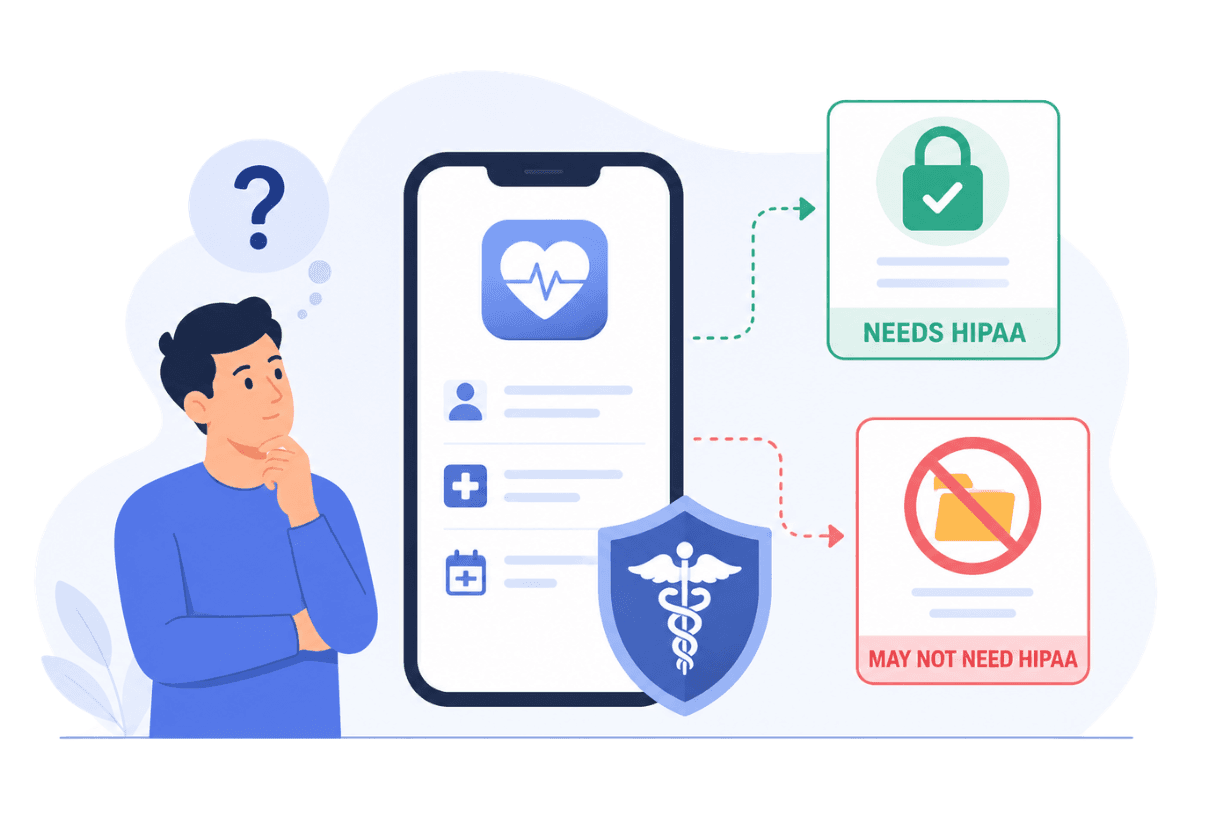
Does Your App Actually Need to Be HIPAA Compliant?
Before spending a dollar on compliance infrastructure, get this question right. The determining factor isn't what kind of app you're building. It's whether your app creates, receives, maintains, or transmits Protected Health Information on behalf of a covered entity.
Here's the honest breakdown:
Your app requires HIPAA compliance if it:
- Stores or transmits patient diagnoses, treatment records, or medication data
- Integrates with an EHR or practice management system and exchanges patient data
- Enables communication between patients and healthcare providers that includes clinical information
- Processes insurance claims or billing data tied to individual patients
- Connects to a covered entity's systems and handles any data they consider PHI
Your app does NOT require HIPAA compliance if it:
- Tracks general wellness metrics without linking them to a covered entity
- Collects fitness or nutrition data that users control entirely themselves
- Operates completely outside any covered entity's ecosystem
Getting this wrong in either direction is expensive. Over-building compliance for an app that doesn't need it wastes months and hundreds of thousands of dollars. Under-building it for an app that does need it risks fines up to $2.19 million per violation category under 2026 OCR enforcement guidelines.
What Changed in 2026 - The New HIPAA Security Rule
If you're starting a healthcare app build right now, you need to understand this before anything else. The updated Security Rule came into effect in May 2026 with a 240-day compliance clock for existing systems. For new builds, compliance from day one is the only viable approach.
Here's what shifted from "addressable" to mandatory:
Encryption at rest - AES-256 is now required, not optional. Any PHI stored on servers, devices, or backups must be encrypted.
Multi-factor authentication - Every user accessing PHI must authenticate through at least two factors. Password alone is no longer sufficient.
Annual penetration testing - Documented third-party security assessments are now required on a yearly basis, not just "periodically."
Network segmentation - Systems handling PHI must be isolated from general network traffic through architectural controls.
Vendor governance documentation - Business Associate Agreements must now include specific security requirement language, not just general compliance obligations.
The practical implication for HIPAA compliant mobile app development is that security architecture decisions made in sprint one now have legal weight they didn't have before. A development partner who doesn't know about these updates isn't a compliance risk on paper. They're a compliance risk in your actual codebase.
The Four HIPAA Rules That Shape Every Technical Decision
HIPAA isn't one rule. It's four, and each one generates specific engineering requirements.
Privacy Rule - Governs what patient data can be used, shared, and disclosed. For developers, this means building granular consent flows, minimum necessary data collection, and patient rights features like data access requests and deletion capabilities.
Security Rule - The rule that most directly drives technical architecture. Requires administrative, physical, and technical safeguards for all electronic PHI. This is where encryption, access controls, audit trails, and the 2026 mandatory requirements live.
Breach Notification Rule - Requires covered entities to notify affected individuals within 60 days of discovering a PHI breach. For developers, this means building breach detection systems and automated notification workflows into the architecture from the start, not as an afterthought.
Enforcement Rule - Sets the penalty structure. Under 2026 OCR guidelines, penalties range from $145 per violation for unknowing violations up to $2,190,294 for willful neglect that isn't corrected. Criminal penalties for intentional misuse of PHI can reach $250,000 and ten years in federal prison.
What HIPAA Compliant App Development Actually Requires Technically
This is where most teams get into trouble. They implement the obvious requirements and miss the ones that trigger OCR investigations.
Technical Safeguards
AES-256 encryption at rest and TLS 1.3 in transit - Every piece of stored PHI encrypted. Every data transmission encrypted. No exceptions.
Role-based access control - Users see only the PHI their job function requires. A billing administrator doesn't need access to clinical notes. A nurse doesn't need billing records.
Multi-factor authentication - Mandatory under the 2026 Security Rule. Biometrics, authenticator apps, or hardware tokens all qualify. SMS codes are no longer considered sufficient by most compliance frameworks.
Immutable audit trails - Every access, modification, and deletion of PHI must be logged with a timestamp, user ID, and action type. Logs must be tamper-proof and retained for a minimum of six years.
Automatic session timeouts - Inactive sessions must terminate automatically. The specific timeout period should be defined based on clinical workflow needs, but the capability must exist.
Emergency access procedures - Documented processes for accessing PHI during system failures or emergencies, with full logging of every emergency access event.
Data purging schedules - Automated deletion of PHI that is no longer required, with documented retention policies and audit evidence of deletions.
Business Associate Agreements
Every vendor that touches your PHI must sign a BAA before any data flows to them. This includes your cloud provider, your monitoring service, your analytics platform, and your email service if it transmits any PHI. Sharing PHI with a vendor without a BAA is itself a HIPAA violation regardless of what that vendor actually does with the data.
HIPAA-eligible cloud vendors with pre-signed BAA programs:
- AWS with HIPAA-eligible services (specific services only, not the entire platform)
- Microsoft Azure Healthcare APIs
- Google Cloud Healthcare API
Important: signing a BAA with these providers doesn't automatically make your implementation compliant. It means the infrastructure layer is available to be configured compliantly. How you configure it is your responsibility.
HIPAA App Development Cost - What It Actually Adds to Your Budget
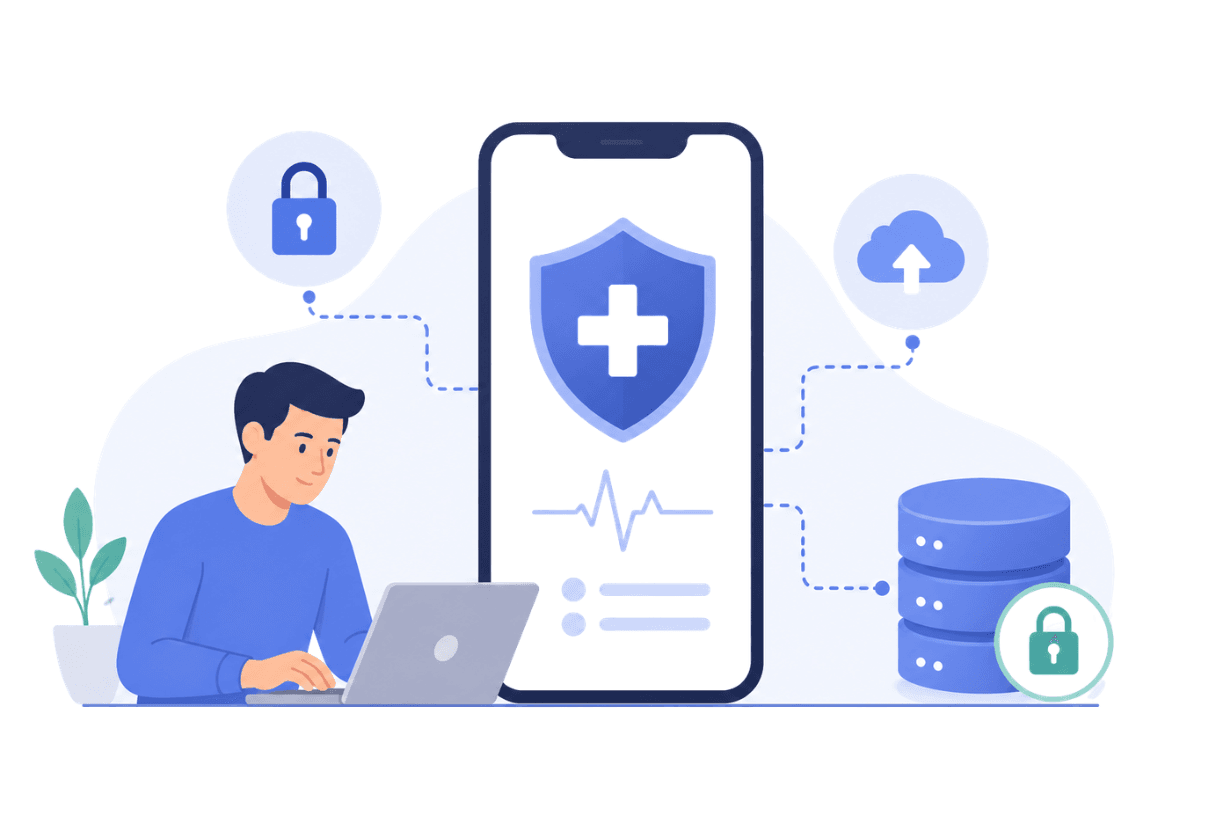
Let me give you the number every guide dances around. HIPAA compliance adds 20 to 35% to your base development cost. Here's exactly where that money goes.
The Compliance Overhead Breakdown
Security architecture and design: 8 to 12% of development cost
Compliance-first architecture takes longer to design and review than standard architecture. Security-focused code review adds sprint time throughout the build.
Encryption implementation: 4 to 6%
Implementing AES-256 at rest and TLS 1.3 in transit across every data layer, including backups, logs, and temporary storage.
Access controls and audit infrastructure: 3 to 5%
Building RBAC, MFA integration, immutable audit logging, and session management that meets compliance requirements.
BAA negotiations and legal: $2,000 to $15,000 fixed
Attorney review of BAAs with each vendor. Healthcare-specific legal counsel is not cheap, but a poorly drafted BAA is worse.
Penetration testing: $5,000 to $25,000 annually
Third-party security assessment required annually under the 2026 Security Rule.
Compliance documentation: 3 to 5%
Policies, procedures, risk analysis, and audit evidence that OCR would request during an investigation.
HIPAA App Development Cost by App Type
Patient communication and scheduling apps: $50,000 to $120,000 with compliance. Timeline 4 to 6 months.
Telemedicine platforms with video consultation: $80,000 to $250,000. Timeline 6 to 9 months.
EHR-integrated clinical tools: $100,000 to $350,000. Timeline 8 to 14 months. HL7/FHIR integration complexity drives the higher end.
AI-powered clinical documentation tools: $120,000 to $400,000. Timeline 8 to 12 months. Model compliance, training data governance, and output validation add significant cost.
Enterprise hospital management platforms: $300,000 to $1,000,000+. Timeline 12 to 24 months.
Where to Build Your HIPAA App in 2026
US-Based HIPAA Development Teams Senior HIPAA-experienced engineers in the US run $120 to $180 per hour. A mid-complexity clinical app with full compliance infrastructure built by a US team typically costs $150,000 to $300,000. You get time zone alignment and easier HIPAA documentation review. You pay a meaningful premium.
India-Based HIPAA Development Teams Experienced HIPAA compliant app development companies in India with proven US healthcare project history run $35 to $65 per hour. The same mid-complexity app costs $60,000 to $130,000. The quality difference founders assume exists mostly doesn't when you work with a team that has shipped compliant US healthcare products before. The compliance requirements are identical regardless of where your development team sits. HIPAA regulates your product and your data, not your vendor's geography. What matters is documented compliance track record, not timezone.
The Hybrid Model Most US Healthcare Startups Use US-based compliance lead or product architect. India-based engineering team. This gives you direct oversight of compliance decisions with significant cost savings on engineering execution. Monthly cost runs $18,000 to $45,000 for a three to four person team. Most of our US healthcare clients end up here.
What Ongoing Compliance Costs After Launch
This is the part most founders don't budget for. Annual compliance overhead runs 15 to 25% of your original development cost:
- Annual penetration testing: $5,000 to $25,000
- Ongoing security monitoring tools: $500 to $3,000 monthly
- BAA reviews when vendors update terms: $1,000 to $5,000 per review
- Staff HIPAA training documentation: $2,000 to $8,000 annually
- Incident response plan maintenance: $1,000 to $3,000 annually
Know these numbers before you start. The build cost is just the first chapter.
How We Evaluate HIPAA Compliant App Development Companies
After building clinical tools across voice AI, chronic care, and remote patient monitoring, we've gotten direct about what separates HIPAA compliant app development companies in the USA and India that deliver from those that create compliance theater.
Four things we check on every engagement:
Show us a product that passed a compliance audit - Not a whitepaper about compliance. An actual deployed product with a documented audit history. Compliance knowledge is worthless without compliance track record.
How do you handle PHI in staging and development environments? - This is the question most teams fail. Production environments get secured. Development environments get forgotten. OCR investigations regularly find PHI sitting in unsecured dev databases.
Who specifically will handle our compliance documentation? - Policies, risk analysis, BAA templates. These aren't engineering deliverables. They require healthcare compliance expertise. Ask which person on the team owns this and what their background is.
What's your breach notification process? - A strong HIPAA compliant software development company has documented incident response procedures before a project starts. Not a plan they'll figure out if something happens.
Pre-Launch HIPAA Compliance Checklist
Use this before you push anything to production. Every item represents something OCR has cited in actual enforcement actions.
Architecture:
- AES-256 encryption implemented for all PHI at rest
- TLS 1.3 configured for all data in transit
- Network segmentation isolating PHI systems from general traffic
- MFA enforced for all user accounts accessing PHI
Access Controls:
- Role-based access implemented and documented
- Unique user IDs assigned to every individual account
- Automatic session timeouts configured and tested
- Emergency access procedures documented and tested
Audit Infrastructure:
- Immutable audit logs capturing all PHI access and modifications
- Log retention policy set at minimum six years
- Real-time alerting for anomalous access patterns configured
- Audit log integrity verification mechanism in place
Vendor Management:
- BAA signed with every vendor touching PHI
- BAA language updated to include 2026 Security Rule requirements
- Cloud infrastructure configured using HIPAA-eligible services only
- Third-party integrations audited for PHI exposure
Documentation:
- Formal risk analysis completed and documented
- Privacy and security policies written and approved
- Incident response plan documented and tested
- Staff HIPAA training completed and recorded
Pre-Launch Testing:
- Penetration test completed by qualified third party
- PHI data flow mapped and verified against access controls
- Data purging schedule implemented and tested
- Breach notification workflow tested end-to-end
How RemoteState Approaches HIPAA Compliant Builds
RemoteState works with US healthcare founders and product teams who need a HIPAA compliant software development company that understands both OCR enforcement standards and the engineering complexity of building in this space
Every engagement starts with a compliance scoping session before any code gets written. PHI data flows get mapped. BAA requirements get identified across the entire vendor stack. The 2026 Security Rule requirements get built into the architecture specification, not retrofitted later.
Teams building HIPAA compliant app development projects at RemoteState include compliance documentation as a parallel workstream to engineering. Policies, risk analysis, and audit evidence are produced alongside code, not assembled in a panic before launch.
Pilot deployments with real clinical users happen before full rollout. Real clinical environments surface compliance issues that testing environments miss every time.
Client Success Story
One of the most technically complex HIPAA compliant mobile app development projects we've shipped was a voice-activated clinical assistant for doctors managing patient records hands-free. Not a dictation tool. A platform where physicians could navigate, chart, prescribe, and update patient records entirely through voice commands while integrating with existing hospital EMR systems.
The Challenge
Building voice AI for clinical settings introduces compliance requirements that don't exist in consumer voice applications. Every transcription of a doctor's voice commands potentially contains PHI. Every prescription suggestion generated by AI must be auditable. Every connection to a hospital's EMR system must go through consent-based data mapping that respects regional privacy requirements across multiple countries.
The team also had to build a data purging scheduler that automatically deleted patient data on documented retention schedules, with audit evidence of every purge event. And the consent flows had to adapt to different regulatory requirements across Australia, where the platform was piloting, and other regions where deployment was planned.
What We Built
Three engineers. One backend engineer (NestJS), one AI/ML specialist, one integrations lead. Seven months from first clinical workflow mapping session to deployed platform.
- Voice-activated transcription pipeline combining Microsoft voice services with custom AI models trained specifically on clinical language, not general speech patterns
- EMR and practice management system integration through MedTech APIs with consent-based hospital data mapping that respected each institution's specific privacy requirements
- AI-powered prescription charting using OpenAI automation balanced against clinical safety requirements and regulatory guidance for automated medical suggestions
- Automated data purging scheduler with documented retention policies and audit-ready evidence of every deletion event
- Consent flows designed for multi-country deployment, adaptable to regional privacy requirements without core architecture changes
Results
- 2,500+ app downloads within the initial rollout period
- 12% revenue rate driven by clinical adoption
- Clinics reported meaningful reductions in manual documentation time, freeing doctors for direct patient care
- Hands-free record management achieved high adoption rates among medical professionals, which is notoriously difficult with new clinical tools
- Hospitals reported improved compliance and operational efficiency in medical data handling across all pilot environments
- Platform architected for global deployment from day one with compliance modules adaptable to multiple regional privacy frameworks
Want to see the complete project breakdown?
Frequently Asked Questions
How much does HIPAA compliant app development cost in 2026?
HIPAA compliance adds 20 to 35% to your base development cost. A basic patient communication app runs $50,000 to $120,000. Clinical tools with EHR integration fall between $100,000 and $350,000. AI-powered platforms push $120,000 to $400,000. Annual compliance maintenance adds another 15 to 25% of your development cost every year after launch.
What are the new HIPAA requirements in 2026?
The May 2026 Security Rule update made several previously "addressable" requirements mandatory. Encryption at rest, multi-factor authentication, annual penetration testing, and network segmentation are now required for all covered entities and business associates. Apps under development now must comply from day one rather than within the 240-day window given to existing systems.
Does my healthcare app need to be HIPAA compliant?
If your app creates, receives, maintains, or transmits Protected Health Information on behalf of a covered entity like a hospital, clinic, or insurer, yes. Wellness apps that operate entirely outside any covered entity's ecosystem generally don't require HIPAA compliance. The gray area is apps that users voluntarily sync with their healthcare providers, which typically don't require compliance unless the provider's covered entity relationship is involved.
How long does it take to build a HIPAA compliant app?
Basic compliant apps take 4 to 6 months. Clinical tools with EHR integration run 8 to 14 months. Enterprise hospital platforms need 12 to 24 months. Any timeline that doesn't include time for compliance documentation, penetration testing, and pilot deployment with real clinical users should be questioned seriously.
Do HIPAA compliant app development companies in India build for US healthcare companies?
Yes. HIPAA is a US regulation but it governs the product and the data, not where the development team is located. Indian development companies with US healthcare project history regularly build HIPAA compliant products for US-based covered entities and business associates. What matters is the team's documented compliance track record and familiarity with OCR enforcement standards, not their geography.
Conclusion
HIPAA compliant app development in 2026 is more demanding than it was twelve months ago. The May Security Rule update closed loopholes that teams had quietly relied on for years. Encryption at rest is mandatory. MFA is mandatory. Annual penetration testing is mandatory. Building around the old "addressable" framework is now a documented compliance failure waiting to happen.
The founders and product teams who get this right in 2026 won't be the ones who found the cheapest development quote. They'll be the ones who started with compliance architecture before a single line of code was written, chose partners who've actually shipped compliant healthcare products, and treated ongoing compliance maintenance with the same seriousness they gave the initial build.
If you're planning a healthcare app build and want to talk through the compliance requirements specific to your product, RemoteState is worth a conversation.
Everything you need to know about HIPAA compliant app development: 2026 security rules, real costs, technical requirements, compliance checklist, and more.


