
Your data sits in six different tools right now. Your sales team uses one system, finance uses another, marketing has its own spreadsheets, and nobody's numbers match when the CEO asks for a report. That's the problem data warehousing is supposed to solve. Most of the time it doesn't, because the platform was the only thing anyone planned for.
We've watched enough US companies burn through six figures learning this the painful way. They buy the license, dump their data in, build a few dashboards, and six months later nobody trusts a single number on any report. The warehouse works fine. The engineering around it doesn't exist.
That gap between a working platform and a working data system is exactly where most projects fall apart. This guide breaks down what data warehousing services actually cost in 2026, which tools hold up under real workloads, and how to spot a partner who builds systems your team will actually rely on.
What Data Warehousing Services Actually Cover
People use this term loosely so let me be blunt about what the real work looks like:
- Designing the warehouse architecture on cloud or hybrid infrastructure
- Building ETL and ELT pipelines that move data from your messy source systems into something structured
- Data modeling so your analytics team can actually query without writing a novel in SQL
- Connecting the BI and dashboard layer so business people see numbers they can trust
- Ongoing performance tuning because queries get slow and storage gets expensive fast
- Security, governance, and access controls that keep compliance teams happy
Any serious data warehousing company also handles the unglamorous upstream work. Cleaning garbage data formats. Normalizing schemas that three different departments set up differently. Building alerts that catch pipeline failures at 2am instead of letting your CFO discover broken numbers during a board meeting.
If someone pitches you a warehouse setup and skips everything I just listed, you're buying a very expensive empty room.
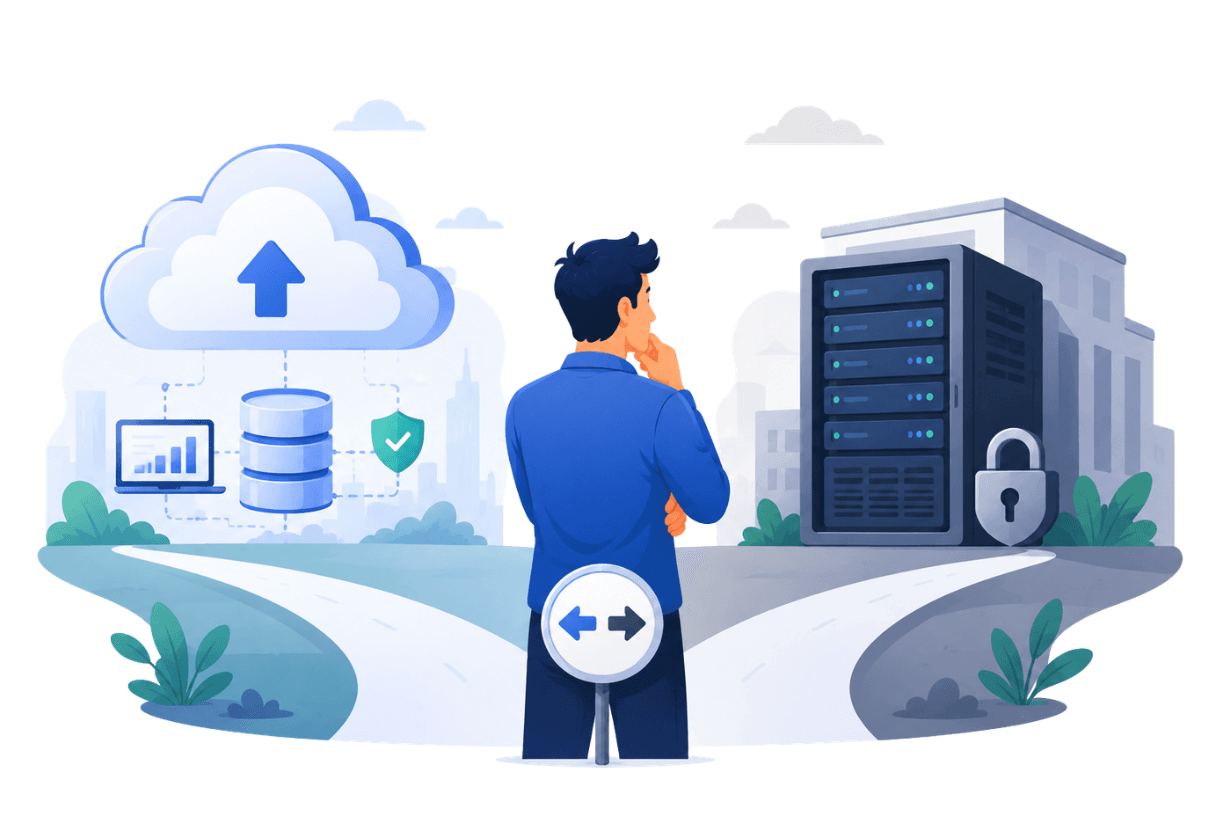
Cloud vs On-Premise: Where Things Actually Stand in 2026
This conversation is mostly over at this point. Unless you're in defense contracting or a heavily regulated industry with strict data residency rules, a cloud based data warehouse is the right move. The flexibility alone makes on-premise hard to justify for most businesses.
Here's how the main platforms stack up right now:
Snowflake - Separates compute from storage which means you stop paying for processing power when nobody's running queries. Best for companies that need multi-cloud flexibility.
Google BigQuery - Completely serverless. Zero infrastructure to manage. You write queries and Google handles everything underneath. Best for teams that want simplicity.
Amazon Redshift - If your company already lives in AWS, this plugs in naturally. The RA3 nodes give you decent separation of compute and storage now.
Databricks - When your warehouse also needs to feed data science and ML workloads. The lakehouse approach works well for teams doing both analytics and model training.
But here's what I keep telling founders. Picking the platform is maybe 20% of the actual project. Building reliable pipelines, clean data models, and dashboards people trust is the other 80%. A cloud based data warehouse without proper data engineering underneath it is just Snowflake with nobody using it.
What This Stuff Actually Costs in 2026
I know you scrolled here first. Everyone does. So here are real numbers, not "it depends" followed by a contact form.
- Basic setup pulling data from 3-5 sources with simple reporting: $30,000 to $80,000
- Mid-complexity builds with custom data modeling, multiple integrations, and proper BI dashboards: $80,000 to $250,000
- Enterprise-scale platforms with real-time streaming, ML-ready data layers, and multi-department governance: $350,000 and up
Now the part that catches people off guard every single time. Those numbers are just the build. Platform licensing, compute costs, storage growth, and pipeline maintenance add 40-50% annually on top of that. A data warehousing as a service model helps because it bundles everything into predictable monthly costs. But you need to know those ongoing numbers before you sign anything.
Whenever we talk to a founder about data warehousing services, I always ask one question. Did your last vendor quote you 18 months or just the build? If they only quoted the build, they either haven't done this enough times or they were hoping you wouldn't ask about the rest.
How We Figure Out If a Data Warehousing Partner Is Actually Good
After building data systems across hospitality analytics, energy platforms, and enterprise reporting, we've gotten pretty good at telling who's real and who's selling slides.
Four things we look for every time:
Pipeline uptime, not platform certifications - Anybody can get a Snowflake partner badge. Ask how many production pipelines they're running right now without failures. That number tells you more than any certification ever will.
They ask about your decisions before your data - A strong data warehousing company wants to know what business questions you need answered before they ask about your source systems. If someone jumps straight to architecture diagrams in the first meeting, they're building the warehouse backwards.
They model your costs before they start building - The best partners will tell you upfront which queries are going to be expensive, where your storage costs will grow fastest, and what optimizations matter most. Vendors who skip this conversation are setting you up for surprise invoices.
They have a real plan for after launch - Pipelines break. Source systems change without warning. New departments want their data added. Data warehousing as a service partners who include monitoring, maintenance, and evolution in the original proposal are almost always worth paying more for. Build-and-disappear shops cost less upfront and way more in the long run.
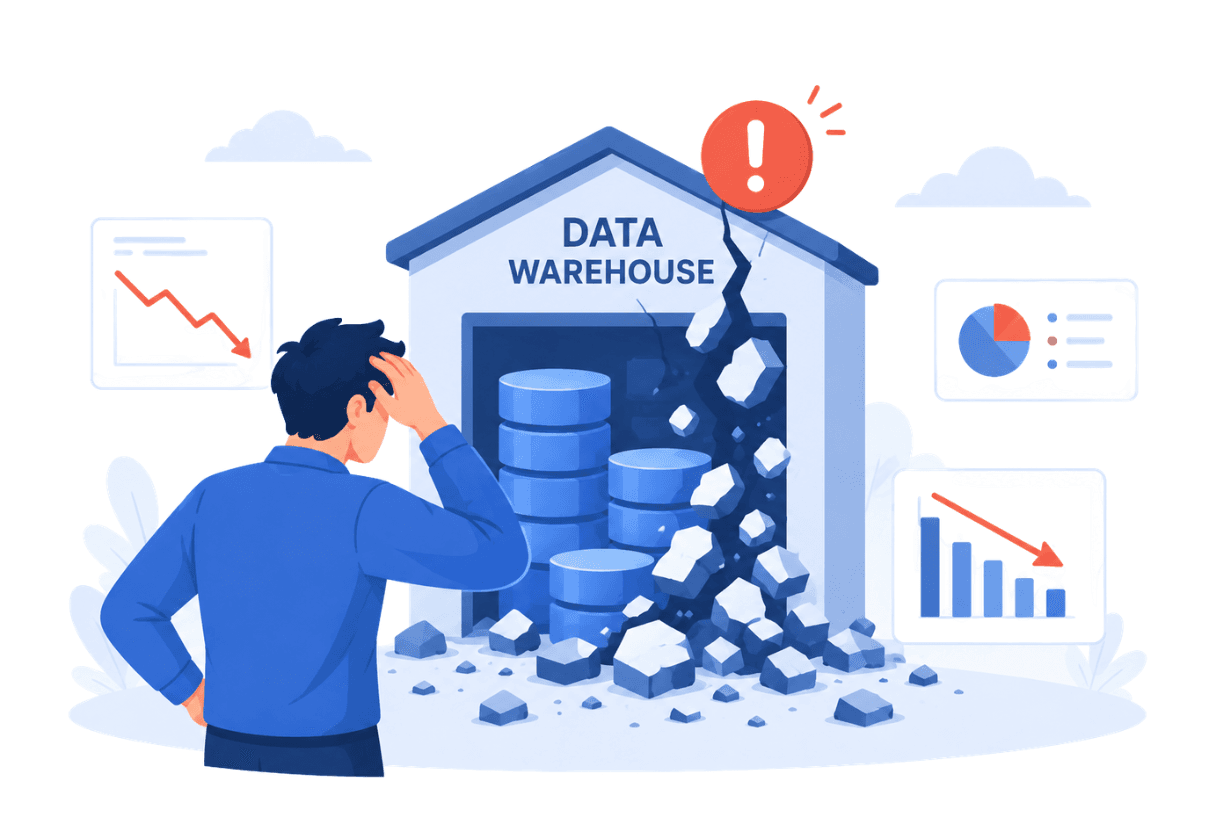
Mistakes That Kill Data Warehouse Projects
I've seen the same ones enough times to list them in my sleep:
Dumping raw data in and calling it a warehouse -
If you skip data modeling, congratulations, you built an expensive data lake and called it something fancier. Model before you migrate. Always.
Ignoring data quality at the pipeline level -
If dirty data gets into the warehouse, every single report downstream is wrong. Validation rules go in the pipeline, not in the dashboard after someone complains.
Building dashboards before the data is trustworthy -
Nothing kills executive confidence faster than two reports showing different revenue numbers for the same quarter. Get the data right first. Dashboards come second.
Treating it like a project with an end date -
A data warehouse is infrastructure. Like your codebase, it needs constant attention. The companies that treat it as a one-time build always end up rebuilding it within two years.
How RemoteState Handles Data Warehousing
RemoteState works with companies that need their data pulled together from scattered systems, cleaned up, structured properly, and turned into something teams actually use for making decisions. Not platform installations with a handoff email. End-to-end systems that people rely on every morning. We start by understanding what decisions your data needs to support. Then we design the warehouse, build the pipelines, model the data, and deliver the reporting layer. Everything sits on cloud infrastructure designed for how your data will look in 18 months, not just how it looks today.
RemoteState's Client Success Story
The Challenge
A hospitality SaaS company was drowning in disconnected data. Booking records lived in one system. Competitor pricing came from separate feeds. Local event calendars sat in spreadsheets. Occupancy metrics came from yet another source. Hotel managers were making pricing decisions on gut feel because nobody could see the full picture in one place. They needed all of that data consolidated into a single cloud-based analytics platform that could power real-time pricing recommendations.
The Solution
RemoteState put together a focused five-person team: two ML engineers, one backend engineer, one frontend developer, and one product analyst. The engagement ran ten months start to finish.
What got built:
- Cloud-based data infrastructure pulling historical booking records, competitor rate feeds, and event calendars into one unified warehouse
- ML models trained on years of aggregated occupancy and pricing data to generate daily rate recommendations
- Real-time competitor rate monitoring with automated parity checks across every booking channel
- Portfolio-wide analytics dashboard showing live occupancy forecasts, revenue trends, and pricing levers
- Forecasting and budgeting modules running entirely on the centralized data layer
Results
- 22% revenue growth across hotel clients using the platform
- 2,800+ properties onboarded from boutique hotels to larger chains
- Managers went from spending hours on manual pricing analysis to getting automated daily recommendations
- First-time adoption of data-driven revenue management for properties that had never used anything beyond spreadsheets
The client put it simply: RemoteState delivered a sophisticated AI pricing tool, guided hands-on integration and dashboard adoption, and made faster, smarter decisions possible across every booking channel.
Want to see the full project?
Read the complete case study here
Frequently Asked Questions
How much does it cost to build a data warehouse in 2026?
Basic setups with a few data sources run $30,000 to $80,000 for the build. Mid-complexity projects with custom modeling and BI dashboards land between $80,000 and $250,000. But the build is just the start. Platform fees, compute, and maintenance add 40-50% per year on top of that.
What is the difference between a data warehouse and a data lake?
A data warehouse stores structured, modeled data ready for reporting and analytics. A data lake stores raw, unprocessed data for flexible exploration and data science. Most production setups in 2026 use both. The warehouse serves business users and dashboards. The lake feeds ML teams and experimental analysis.
Cloud data warehouse or on-premise: which one should I pick?
Cloud for almost everyone. The scalability, cost flexibility, and zero hardware maintenance make it the obvious choice unless you have strict data residency or regulatory requirements that mandate on-premise. Snowflake, BigQuery, and Redshift cover the vast majority of use cases.
How long does it take to build a production data warehouse?
A basic warehouse with pipelines for 3-5 data sources takes 6-10 weeks. Complex builds with multiple departments, real-time streaming, and custom data models typically run 4-7 months. Any timeline that doesn't include data quality validation and user testing should be questioned seriously.
What is data warehousing as a service and is it worth it?
Data warehousing as a service bundles platform infrastructure, pipeline management, monitoring, and ongoing support into a managed monthly model. It's worth it for companies that want production-grade data infrastructure without hiring a full internal data engineering team. The predictable cost structure alone makes budgeting significantly easier.
Conclusion
Data warehousing in 2026 isn't a platform conversation. It's an engineering conversation. The platform is just the container. What goes inside it, how the data gets there, how it's modeled, and how people access it, that's where the real work lives. The companies getting genuine value from their data didn't spend the most on licenses. They spent wisely on the engineering around the platform and treated the warehouse as living infrastructure that grows alongside their business. If your data is scattered across a dozen systems and your dashboards show numbers nobody believes, RemoteState can fix that.
Looking for a data warehousing services in USA? Real costs, tool comparisons, and what separates partners who deliver from those who just demo well.


