
So your backend needs to handle thousands of concurrent requests and you've realized Python or Node isn't going to cut it anymore. Or maybe you already know Go is the right call, you just need the right people to actually build the thing.
Here's the catch though. Go talent is weirdly hard to find compared to JavaScript or Python. Fewer developers, different hiring signals, and a lot of candidates who learned Go syntax from a weekend course but have never touched a production microservice. We've spent enough time placing and managing Go engineers across real projects to know what actually works and what wastes your time.
How We Evaluate Go Engineering Talent
Fair warning, this guide isn't pulled from job board stats or "top skills for 2026" roundups. It comes from actually sitting across the table from Go candidates, reviewing their code, and watching what happens when they join a real sprint team.
We look at four things every single time:
Concurrency depth - Can they genuinely design systems around goroutines and channels, or did they just memorize the basics for the interview
Production scars - Have they ever been woken up at 2am because a Go service fell over under load. That experience changes how someone writes code
Systems-level instincts - Do they think about memory, garbage collection, and profiling naturally or only when someone asks
Architecture judgment - When you throw a tradeoff question at them, gRPC versus REST, monolith versus microservices, do they reason through it or just pick the trendy answer
The skills, costs, and interview questions below come from patterns we've watched repeat across dozens of engagements. Not theory. Pattern recognition from doing this over and over.
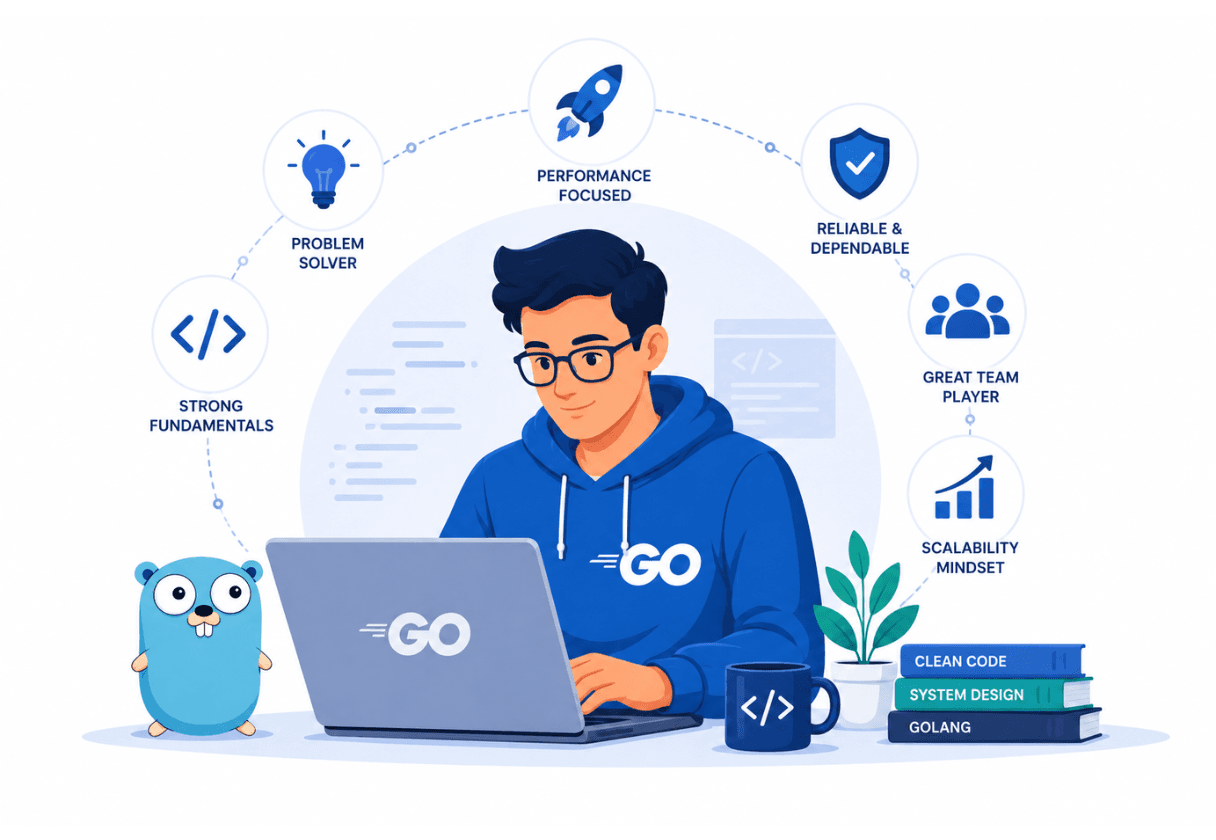
What Makes a Strong Go Engineer Worth Hiring
Before you write a single job posting, you need to know what you're actually looking for. There's a real difference between a competent hire golang engineer and somebody who finished an online course last month and added Go to their LinkedIn.
Go attracts a certain type of engineer and you want to screen for that mindset specifically:
Concurrency patterns -
Goroutines and channels are basically Go's whole personality. A good candidate should be able to tell you exactly when buffered channels make sense over unbuffered, and when sync.WaitGroup is the better move. If they fumble this, everything else is a red flag.
Standard library instincts -
Go ships with an absurdly good standard library. The strong ones build HTTP servers, parse JSON, and handle I/O without immediately reaching for some third-party package they found on GitHub. That restraint tells you a lot about how they think.
Systems thinking -
Memory allocation, GC tuning, profiling with pprof. These aren't nice-to-haves. If your candidate has never wrestled with performance in a live service, they're going to learn on your dime. And that gets expensive fast.
API and microservices chops -
REST and gRPC fluency, protocol buffer experience, service discovery patterns. This is table stakes for any serious Go project in 2026.
Someone who ticks these boxes will hit the ground running within your first sprint. Someone who only knows syntax will spend that same sprint figuring out why their goroutines are leaking memory.
How Much Does It Cost in 2026
Every founder asks this first so let's just get into it. When you hire dedicated golang developers, what you pay depends almost entirely on where they sit, how senior they are, and how you structure the engagement.
North America: $80 to $150 per hour for mid-to-senior folks. Full-time salaries land between $140K and $200K+ if you're hiring in SF, NYC, or Seattle.
Western Europe: $60 to $110 per hour. Berlin and Amsterdam run a bit cheaper than London but the gap is closing.
India: $25 to $55 per hour for engineers with the same distributed systems training. When you hire dedicated golang developers India, you're getting 60% cost savings without the skill compromise most people expect. We've placed enough engineers from this corridor to say that confidently.
Eastern Europe and Latin America: $40 to $75 per hour. Poland, Ukraine, Argentina, and Brazil all have surprisingly strong Go communities that most hiring teams overlook.
If you're a startup watching your runway, India and Eastern Europe are where most of our clients land the best balance of skill and cost. Bigger companies with compliance needs usually go with an onshore tech lead paired with an offshore engineering pod.

Where to Find Golang Developers Who Actually Ship
This is the part most hiring guides gloss over. Sure, there are golang developers for hire everywhere. LinkedIn, Upwork, Toptal, you name it. But finding ones who've actually built, deployed, and maintained production Go systems is a different game entirely.
The channels that actually produce strong candidates in 2026:
Specialized agencies with Go project history -
Ask them to show you a Go project they shipped that scaled. If they can't, you already have your answer.
Go-specific communities -
The Gophers Slack workspace, GopherCon alumni circles, and r/golang on Reddit. The engineers hanging out in these spaces tend to genuinely care about the language. Passive candidates from here often outperform the active job seekers applying through normal channels.
Open source contributions -
If someone's actively contributing to Go projects on GitHub, that tells you they're invested in the ecosystem for real. Look at their commit history though, not just how many stars their repos have.
Staff augmentation partners -
When you need to hire remote golang developers without standing up a whole recruitment operation, a dedicated team model plugs engineers straight into your sprint cycles. Less overhead, faster start.
One thing I'd strongly avoid: generic freelance marketplaces for anything mission-critical in Go. The screening burden lands entirely on you, and doing Go-specific vetting well without in-house expertise is genuinely difficult.
Interview Questions That Reveal Real Go Expertise
Resumes give you a rough picture. Take-home tests help a little more. But the interview itself is where you actually figure out if someone builds things or just follows tutorials. These questions come from dozens of golang developers for hire we've screened for client teams over the past couple years.
Start with architecture
"Walk me through how you'd design a rate limiter for a multi-tenant API in Go." You'll immediately see whether they think about concurrency, production constraints, and system design as one connected problem or three separate topics.
Then go into debugging
"You're seeing goroutine leaks in a service processing 10K requests per second. How do you find and fix it?" A strong hire golang engineer will start talking about pprof, context cancellation, and specific leak patterns. Someone out of their depth will say something about restarting the pod.
Finish with tradeoffs
"When would you pick gRPC over REST for service-to-service communication, and when wouldn't you?" This is where you see real project judgment. Textbook answers sound different from answers that come from actually making that decision on a real build.
Picking the Right Engagement Model
Different projects need different setups and getting this wrong wastes more time than most people realize. If you need to hire remote golang developers for a focused 3 to 6 month build, a dedicated team model gives you sprint-embedded engineers without the long-term payroll weight. For ongoing product work where the codebase keeps growing, direct hires or retainer arrangements make more sense.
The real deciding factor is continuity. Go codebases develop their own concurrency patterns and error-handling rhythms over time. Engineers who understand those patterns intimately write better code and break fewer things. Swapping freelancers every quarter introduces compounding risk that most teams don't notice until something important breaks in production.
How RemoteState Builds Go Engineering Teams
Most agencies say they have Go developers. Fewer have actually shipped Go systems that handle production traffic at scale. At RemoteState, Go engineering pods are built around the specific concurrency and performance demands of your project, not pulled from a generic talent bench.
The process starts with understanding your architecture, your traffic patterns, and where your current team has gaps. From there we assemble a tight, focused group, usually 2 to 4 engineers, who embed directly into your sprints and own delivery from day one. No warm-up months. No syntax-level learners figuring things out on your budget.
What This Looks Like in Practice: A Real Client Build
One of our US-based clients in the communication space needed a real-time messaging platform that could handle encrypted conversations, multimedia sharing, and horizontal scaling for a user base that was growing faster than their existing architecture could keep up with. This wasn't a chatbot project. Concurrency was literally the entire architecture.
Challenge
Build a microservices backend handling real-time encrypted messaging, threaded conversations, granular access control, and API/SDK layers for third-party integrations. All of it needed to scale horizontally without falling over when traffic spiked.
What we delivered
Two backend engineers, one frontend developer, and one security specialist working across a 7-month engagement. The architecture split into modular microservices covering messaging, encryption, media handling, and permission management. This is exactly the kind of build where you want to hire golang web developer talent that understands concurrency at the infrastructure level, not just the language level.
Results
- 25,000+ app downloads after launch
- 13% revenue conversion driven by platform reliability and uptime
- End-to-end encryption shipped across every channel from day one
- API/SDK layer delivered for third-party integrations
- Full build from ideation to deployment completed in under 9 months
Builds like this are why we have strong opinions about what to look for when you hire golang web developer candidates. Knowing Go syntax is the easy part. Having solved concurrency problems under real production pressure is what actually matters.
Want to see the complete project breakdown? Read the full case study here
Ready to Build Your Go Engineering Team?
If you're building microservices, real-time platforms, or high-concurrency backends, the engineers you pick will make or break the project. At RemoteState, we put together Go-focused engineering pods that plug straight into your sprints. Whether you want to hire dedicated golang developers India for cost efficiency or need a blended onshore-offshore setup, we build the team structure around your project, not the other way around. Let's talk at remotestate.com
Frequently Asked Questions
How much does it cost to hire a Golang developer?
Rates run from $25 to $55/hour in India up to $80 to $150/hour in North America depending on seniority and engagement model. Dedicated team setups from agencies usually deliver better value than hiring individual freelancers for production-grade work.
What skills should a Golang developer have?
Concurrency with goroutines and channels, strong standard library knowledge, microservices architecture, gRPC/REST API design, and production debugging with pprof. In Go, systems-level thinking matters way more than knowing a lot of frameworks.
Where can I hire Golang developers?
Specialized development agencies, the Gophers Slack community, GopherCon alumni networks, and open source contributor pools are your strongest bets. Stay away from generic freelance platforms for anything backend-critical.
Golang developer vs Node.js developer: which should I hire?
Go wins for CPU-bound workloads, high-concurrency microservices, and anything where raw performance is the priority. Node.js is better for I/O-heavy web apps and teams that want shared frontend-backend code. If concurrency and latency are your bottlenecks, Go is the answer.
How long does it take to hire a Golang developer?
Through traditional channels, expect 4 to 8 weeks. Agencies with pre-vetted Go talent can place engineers in 1 to 2 weeks. Because the Go talent pool is smaller than mainstream languages, starting your search early matters more than usual.
Final Thoughts
Hiring Go developers in 2026 isn't necessarily harder than hiring in other languages. It just works differently. The talent pool is smaller but the people in it tend to be more deliberate about their craft. Engineers who choose Go usually care deeply about performance, simplicity, and building things that actually hold up in production. Your job is to build a hiring process that finds those people and doesn't waste their time or yours in the process.
Hire dedicated Golang developers in 2026 to build scalable, high-performance applications with flexible hiring models and proven Go expertise.


