

Your AI pilot worked beautifully in the demo. Then it met your real data, your legacy systems, and your actual users, and stalled.
That gap between “works in a demo” and “works in production” is why so many companies are now looking for forward deployed engineers. It’s also why the title shows up on so many job boards and in so many board-level conversations.
This guide answers what is a forward deployed engineer from the buyer’s side: what they do, how an engagement works, what they cost, and how to tell whether your project needs one.
What Is an FDE?
So, what is a forward deployed engineer? It’s a software engineer who works directly inside a customer’s environment, alongside their team, to build, integrate, and deploy a solution until it delivers results. They own the outcome, not just the code.
The FDE meaning is simply Forward Deployed Engineer. You’ll also see the role called a forward deployed software engineer, a forward deployment engineer, or a forward deploy engineer. They all describe the same job.
What does “forward deployed” mean? The term borrows from military language for units stationed close to the action rather than at headquarters. Palantir popularized the role by embedding engineers with government and enterprise customers whose problems couldn’t be solved from a distance.
Here’s the simplest way to think about it. A traditional engineer builds the product. A forward deployed engineer makes it work in the field.
What an FDE Does Day to Day

The FDE role sits between engineering, consulting, and product. In practice, most of the work falls into five areas:
- Understanding the real problem. FDEs sit with stakeholders and end users to learn how work actually happens, which is often different from what the requirements document says.
- Building what’s missing. That includes custom integrations, data pipelines, workflow logic, and features the core product doesn’t yet support.
- Connecting to existing systems. ERPs, CRMs, databases, and internal APIs all need to talk to the new solution without breaking what already works.
- Deploying to production. FDEs handle the last mile: security reviews, infrastructure, monitoring, and rollout.
- Feeding lessons back. They see where the product falls short in real use and turn that into input for the product team.
The common thread is ownership. Forward deployed engineers stay until the solution works for real users, not just until the code ships.
How a Forward Deployed Engagement Works
Most forward deployed engineering engagements follow the same five stages. The FDE model works because each stage happens close to the customer, not in a separate office.
- Discovery - The FDE maps workflows, data sources, and pain points before writing any code.
- Embedding - They join the customer’s standups, tools, and communication channels, and become part of the team.
- Building - Prototypes come first, tested against real data, then the full solution.
- Deploying - The solution goes live in the customer’s cloud or on-premise environment, with monitoring in place.
- Handing off - Documentation, training, and knowledge transfer let the customer’s team run it independently.
Fair warning: stage one is where most of the value hides. Teams that skip discovery to start building faster usually end up rebuilding later.
Skills That Matter in an FDE Engineer
A strong FDE engineer combines solid engineering with the instincts of a good consultant. If you’re evaluating someone for the role, look at both sides.
Technical skills:
- Fluency in at least one major language, typically Python, TypeScript, or Go
- Deep experience with APIs, integrations, and data pipelines
- Hands-on work with AWS, GCP, or Azure
- Practical knowledge of LLMs, RAG systems, and AI tooling
- Comfort with SQL and messy real-world data
Client-facing skills:
- Translating business problems into technical plans
- Explaining trade-offs to non-technical stakeholders
- Making sound decisions when requirements are unclear
- Taking ownership of outcomes, not just tasks
The second list is harder to find. Plenty of engineers can build an integration. Far fewer can sit in a room with a frustrated operations team and figure out what they actually need.
The FDE’s Role in AI Development
AI is where the role has grown fastest. AI models are easy to show off and hard to put into production, and an AI forward deployed engineer is the person who closes that gap.
The work looks different from a typical software deployment. An AI FDE adapts RAG pipelines to a customer’s documents, connects agents to internal tools, sets up evaluation so the team can measure accuracy, and adds guardrails before anything reaches real users.
Here’s what nobody mentions in AI vendor pitches: the model is rarely what breaks. What breaks is the data, the permissions, the integrations, and the workflows around it. That’s why forward deployed AI engineers spend most of their time outside the model itself.
If you’re planning an AI rollout, this work maps directly to the integration and deployment phase of an AI implementation roadmap. It’s also why companies increasingly look for an AI forward deployed engineer instead of a general AI deployment engineer: the job is as much about the customer’s environment as about the technology.
FDE vs. Software Engineer vs. Similar Roles
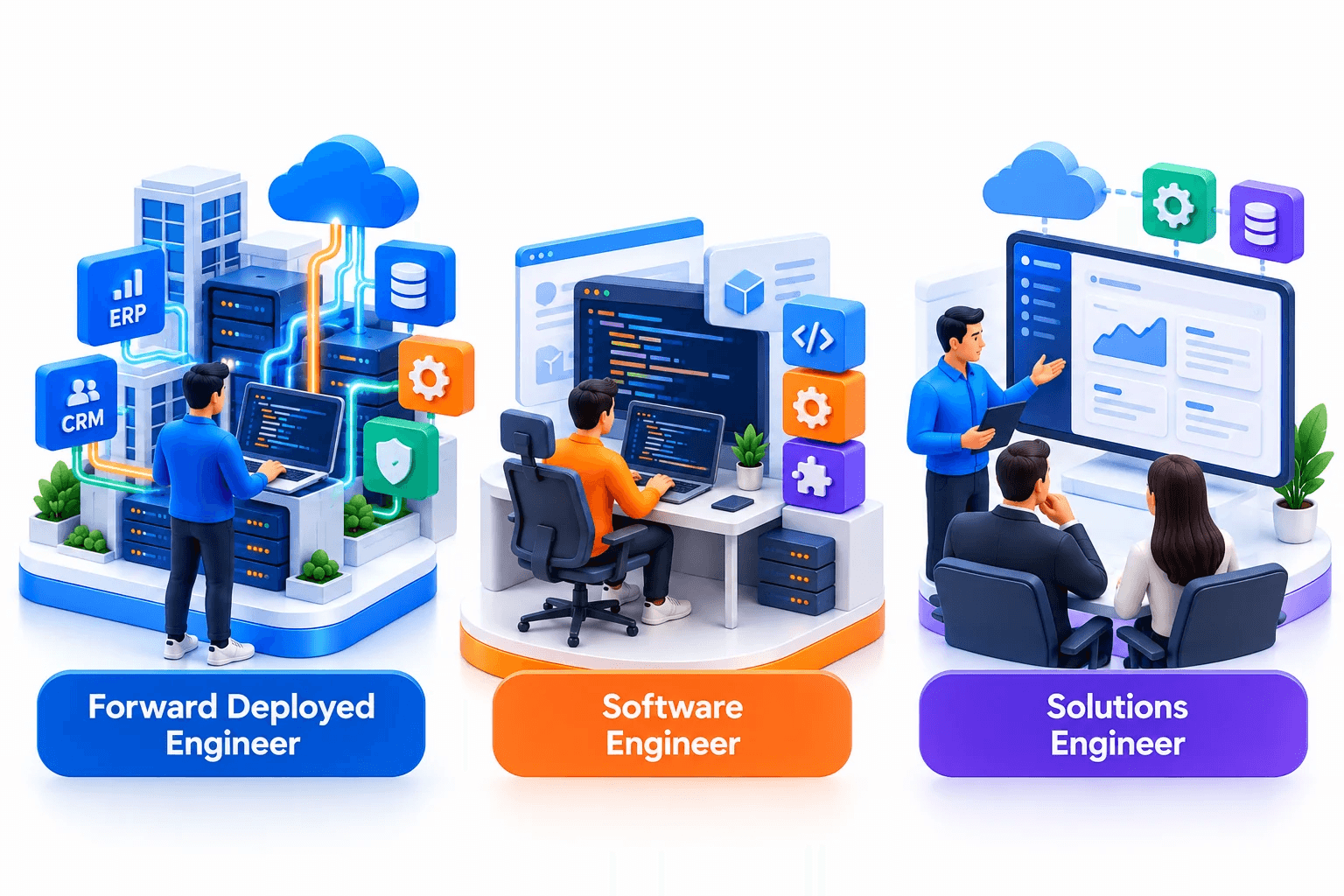
Buyers often confuse forward deployed engineers with other roles. The differences matter, because they change what you’re paying for.
| Forward deployed engineer | Software engineer | Solutions engineer | Staff augmentation developer | |
|---|---|---|---|---|
| Main output | A working solution in the customer’s environment | Product features for many users | A product configured to fit the customer | Code against your existing roadmap |
| Works with | Customer stakeholders and end users | Internal product team | Sales and customer teams | Your engineering team |
| Owns | The outcome | Their part of the codebase | The technical sale and setup | Assigned tasks |
| Builds custom code | Yes, whatever the customer needs | Yes, for the product | Rarely | Yes, as directed |
| Measured by | Adoption and results | Feature delivery | Deal and setup success | Velocity and output |
A forward deployed software engineer writes production code like any software engineer. The difference is direction. A software engineer builds for a roadmap. A forward deployed engineer builds for one customer’s real problem.
The line with staff augmentation is the one buyers get wrong most often. Staff augmentation adds hands to your roadmap. An FDE takes ownership of a problem and decides what to build.
What a Forward Deployed Engineer Costs: In-House vs. Partner

I’ll be straight with you: in-house FDEs are expensive. Paraform’s pay data puts US forward deployed engineer base compensation at $150,000 to $217,000, with a midpoint of $183,000.
That’s base pay only. Add benefits, equity, and recruiting. Second Talent’s market data shows permanent placements typically cost 15% to 25% of first-year salary in recruiter fees, and then there are the months it takes a new hire to ramp up.
| Engagement model | Typical cost | Best for |
|---|---|---|
| In-house US hire | $150,000 to $217,000 base, plus benefits and hiring costs | Long-term, ongoing FDE workload |
| US freelance contractor (mid-level) | $119 to $185 per hour | Short projects with clear scope |
| US agency or dev shop (mid-level) | $230 to $380 per hour | Fully managed delivery |
| Offshore FDE | $5,000 to $15,000 per month | Cost-sensitive, ongoing work |
Contractor and agency rates are from Second Talent’s September 2026 market data. These are market ranges, not quotes.
The forward deployed AI engineer consulting model sits between these options. You get an embedded engineer with partner-level accountability, without the full cost of a US hire. The trade-off is time-zone overlap and how much on-site presence you need, so ask any partner exactly how they handle both.
How We Decide If a Project Needs an FDE
Knowing the FDE meaning is the easy part. Deciding whether your project actually needs one is harder. We look at four criteria:
Integration Complexity
Does the solution have to connect to several systems owned by different teams? One clean API doesn’t need an FDE. Five legacy systems usually do.
Customer-specific Workflows
Will the solution need to adapt to how each customer or business unit actually works? Standard workflows can be handled remotely. Unique ones need someone close to the users.
Deployment Risk
Are there sensitive data, compliance requirements, or security reviews involved? Higher risk means more value from an engineer who validates everything inside the real environment.
Feedback Urgency
Do you need fast learning from real users to shape the product? FDEs create a direct line from the field back to engineering.
If three or more apply, forward deployed engineering is likely worth the investment. If only one does, a standard development team or staff augmentation will usually be enough, and cheaper.
How RemoteState Works With Forward Deployed Engineers
Everything above describes the role. The practical question for most US companies is how to get FDE-level ownership without paying FDE-level US salaries.
That’s the model behind RemoteState. When you hire forward deployed engineers through us, you get India-based engineers who work directly alongside your team and customers, with on-site availability when the work calls for it. They cover US, European, and Asia-Pacific hours, so go-live windows and urgent issues don’t wait for the next day.
You can engage them full-time, part-time, or hourly, and start with a 14-day risk-free trial. RemoteState has delivered more than 140 solutions with 98% client retention.
Proof: AI inside a live clinical workflow
One of our closest examples of embedded-style delivery is a voice-activated clinical assistant we built for a healthcare provider. The assistant had to integrate with EMR systems and automate prescription workflows using OpenAI.
That’s forward deployed work at its core. The AI only mattered once it worked inside the clinical systems and routines staff already used, with every write into a patient record tightly controlled.
Conclusion
The short answer to what is a forward deployed engineer: an engineer who owns the last mile, turning a product or AI system into something that works inside a real business.
Not every project needs one. But when integrations are complex, workflows are unique, and the stakes are high, an FDE is often the difference between a stalled pilot and a working system.
If your project fits that description, you can hire forward deployed engineers through RemoteState and start with a 14-day risk-free trial.
Frequently Asked Questions
Most AI demos never survive a real customer environment. Forward deployed engineers fix that. Here’s what they do, the skills they need, and what they cost.


