
I'll tell you what changed. Two years ago if you suggested outsourcing your Go backend to an offshore team, most US engineering leads would look at you like you'd lost it. Now? Half the ones we talk to are either already doing it or figuring out how to start.
And honestly I get why. Senior Go developers in the US run $180K to $200K+ when you add up salary, benefits, and all the stuff nobody mentions in the job post. The hiring cycle drags on for 3 to 5 months. And even after all that pain, your new hire might bounce in a year because someone across town waved an extra $20K at them. Meanwhile your CTO is writing backend code at midnight because there's literally nobody else to do it.
Golang development outsourcing didn't blow up because it's the cheap option. It blew up because the "normal" way of building Go teams in the US stopped working for most companies. This guide gets into what it actually costs, which setups deliver results, and where things go wrong when people rush into it without thinking.
Why US Companies Are Outsourcing Go Development Right Now
Something shifted and it wasn't just one thing. A few forces hit at the same time.
The Talent Gap Is Real
Go's developer pool is still tiny compared to JavaScript or Python. Around 5.8 million developers worldwide write Go, which sounds decent until you realize that's roughly 4% of all developers on the planet. Now try finding senior ones in the US who've actually built and maintained production Go systems. Good luck. We've watched clients search for months and come up empty.
The Math Changed
Here's the part that gets people's attention fast. A mid-senior Go engineer in San Francisco runs you $150 to $200 per hour when you factor everything in. That same skill level from India or Eastern Europe? $30 to $65. Do the math on a three-person Go pod and you're looking at $300K to $500K saved per year. That's not a minor optimization. For a startup that's the difference between runway lasting 12 months or 18.
Remote Engineering Grew Up
The tooling finally caught up to the ambition. Async workflows, GitHub-native collaboration, mature CI/CD pipelines. An offshore Go team running well can ship at the same pace as a local one. I know that sounds like something every outsourcing company says but we've actually seen it play out consistently when the setup is done right. The disasters from ten years ago mostly happened because the tools weren't there yet. Now they are.

What Golang Development Outsourcing Actually Costs in 2026
I know you probably scrolled here first. Everyone does. So here are actual numbers, not a "schedule a call" button.
By Region
India: $25 to $55 per hour for mid-to-senior Go engineers. Biggest talent pool outside the US by far. When you compare golang development outsourcing pricing across every corridor, India keeps coming out on top for pure value.
Eastern Europe (Poland, Ukraine, Romania): $40 to $75 per hour. Solid Go communities and the time zone overlap with US East Coast makes real-time pairing sessions actually doable.
Latin America (Argentina, Brazil, Mexico): $35 to $65 per hour. Nearshore advantage is real. But the senior Go talent pool is thinner than India or Eastern Europe right now. Growing fast though.
US-based outsourcing: $80 to $140 per hour. All the overhead of a full-time hire, none of the long-term commitment. Only makes sense when compliance or security clearance specifically requires US-based engineers.
By Engagement Model
Dedicated team: $8,000 to $25,000 per month per engineer depending on how senior they are and where they sit. This is what works best for anything beyond a quick project because Go codebases need engineers who build context over time.
Project-based: $30,000 to $150,000+ depending on what you're building. Fine when the scope is genuinely locked. But I'll be honest, Go projects almost always uncover new requirements the moment real data or real traffic enters the picture. Budgets blow up when scope was frozen too early.
Staff augmentation: Hourly rates as listed above. Fills specific gaps on your existing team. But this only works when you've already got a senior Go architect internally who can direct the work. Without that anchor person, augmented engineers build pieces that don't connect.
What Budgets Miss Every Time
Those numbers are just the engineering hours. Nobody mentions this during the sales pitch but cloud compute for running Go services, monitoring tools, CI/CD pipeline costs, and security audits add another 20 to 35% on top. Know that number before you sign anything.
Which Outsourcing Model Actually Works for Go Projects
I've seen all three play out dozens of times. Here's what I've learned about when each one delivers and when it falls on its face.
Dedicated Team - Best for Most Go Projects
Here's the thing about Go codebases. They develop their own personality over time. Specific concurrency patterns. Particular error handling approaches. Architectural opinions that only make sense if you've been living in the code for months. Engineers who build that context write dramatically better code than ones who parachute in for six weeks. That's why most golang development services engagements that actually succeed long-term run on the dedicated team model. It's not the cheapest per month. It's the cheapest per outcome.
Project-Based - Only When Scope Is Genuinely Fixed
Building one specific microservice. Migrating a single API from Python to Go. Adding a well-defined feature to an existing Go system. These work as project-based gigs. Anything messier or more open-ended? You'll hit scope changes that make the original quote look like a fantasy. Not because anyone did anything wrong. Because that's just how software works, especially in Go where the type system and concurrency model surface design issues you didn't know you had.
Staff Augmentation - Only With a Strong Internal Anchor
Two outsourced Go engineers joining a team that already has a senior Go architect running things? Beautiful. Works great. Two outsourced Go engineers joining a team where nobody has written Go before? That's how you end up with four microservices that each handle errors differently and a deployment pipeline held together with duct tape. Golang development services through augmentation absolutely need an internal anchor or the whole thing drifts.
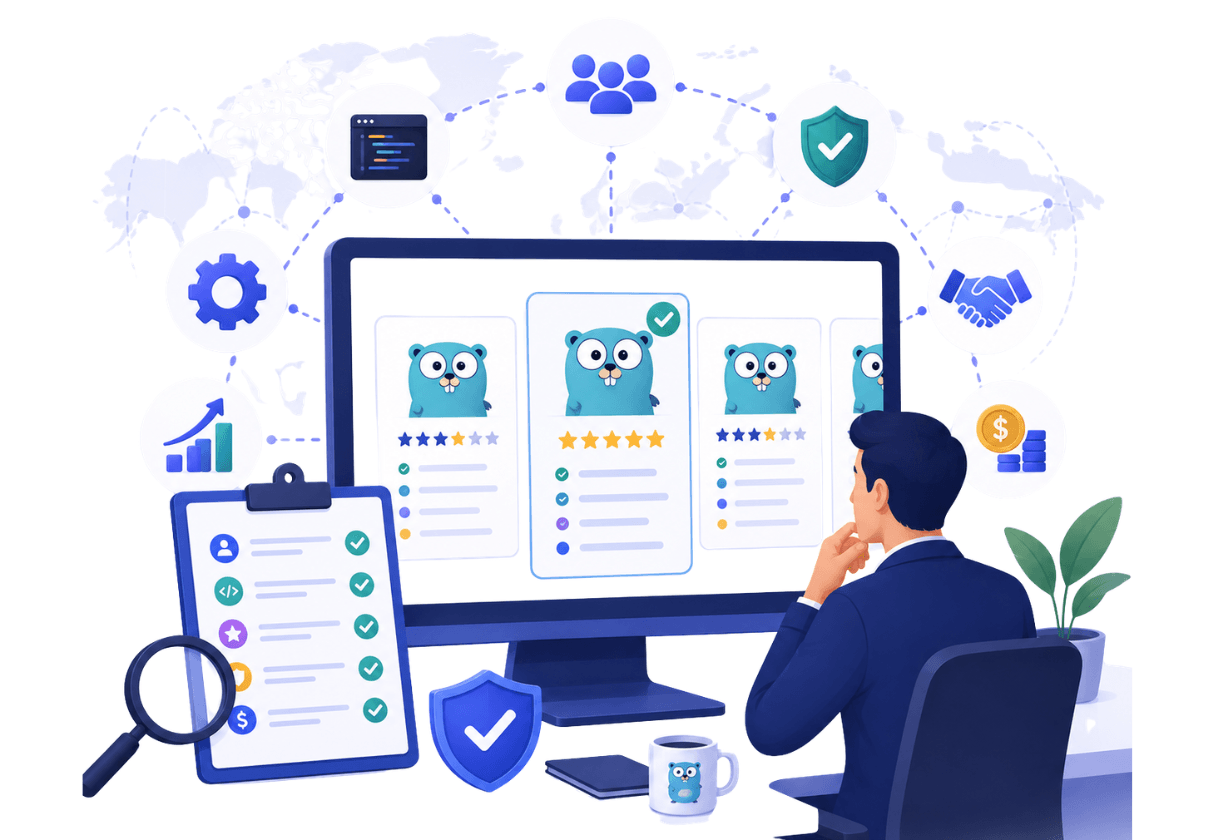
How We Evaluate Golang Outsourcing Partners
After a few years of building Go infrastructure for US companies, we've gotten pretty blunt about what separates real partners from smooth talkers. Four things we look at every single time.
Production Go systems that would wake someone up if they broke - Not prototypes. Not hackathon projects. Not that one microservice they rewrote from Node "to learn Go." Systems running real traffic that someone's on-call for. If they can't point to those, they're still practicing.
Concurrency chops you can actually verify - Go's entire selling point is concurrency. If their engineers can't talk through a goroutine leak diagnosis or explain why unbuffered channels are deadlocking in a specific scenario, they picked up Go from a weekend course. You'll discover this at the worst possible time. On your project. Under load.
They own the full stack, not just app code - The best golang outsourcing development services teams handle CI/CD, containerization, monitoring, and alerting as part of the engagement. If they only write application logic and expect you to figure out everything around it, you're buying a half-service and paying for the other half with your own team's time.
You know exactly who's working on your project - Names. Backgrounds. How long they've been with the company. Turnover on outsourced Go teams is the silent killer nobody warns you about. The engineer who finally understood your codebase's concurrency patterns leaving after four months can set the project back further than the money you saved by outsourcing in the first place.
Mistakes That Kill Go Outsourcing Engagements
I see the same ones over and over. At this point I can almost tell which projects are going to struggle just from how the first two weeks go.
Picking whoever quotes the lowest rate - Cheapest Go developer on paper almost always writes the most expensive code in practice. An engineer at $25/hour who doesn't understand Go's memory model will ship goroutine leaks that take your senior engineers weeks to diagnose and fix. You saved money on paper and lost it three times over in reality.
Zero time zone overlap - You don't need to work the same hours but you absolutely need 3 to 4 shared hours every day. Standups, code reviews, the quick "hey can you look at this" conversations that prevent small misunderstandings from turning into expensive rework. Without overlap those small things compound silently until something big breaks.
Expecting day-one productivity - Even a great Go engineer needs 2 to 3 weeks to learn your specific codebase patterns, deployment flow, and the architectural decisions that aren't written down anywhere. Skipping onboarding because "they're experienced" is how you get code that technically works but fights every convention your team has built.
Keeping outsourced engineers at arm's length - Same Slack channels. Same standups. Same sprint goals. Same retro. When you treat outsourced engineers like part of the product team, they deliver like part of the product team. When you keep them in a separate silo and communicate through a project manager's weekly email, they deliver like contractors who don't really care. Because why would they.
How RemoteState Handles Golang Outsourcing
RemoteState puts together Go engineering pods specifically for US companies that need backend infrastructure shipped without spending half a year trying to hire locally.
We start by getting into your architecture. Your traffic patterns. Where your current team has holes. Then we assemble a small group, usually 2 to 4 engineers, who plug directly into your sprints. They're not working off a spec in a different time zone wondering what you meant. They're in your Slack, your GitHub, your daily standup, your retro.
Every golang outsourcing development services engagement we run includes infrastructure ownership as a default. CI/CD pipelines, monitoring dashboards, deployment automation. The full picture. Not just application code tossed over a wall.
RemoteState's Client Success Story
One of our US clients came to us with a problem that made my head hurt just hearing about it. They needed to pull real-time vehicle telematics data from over 70 different hardware providers into one unified analytics platform. Seventy. Each one with its own API format, authentication method, rate limits, and error handling quirks.
The Challenge
Building flexible connectors that could normalize completely different data formats from 70+ telematics providers. Everything had to flow in real time with zero data loss, full observability, and the kind of security that enterprise fleet companies demand before they trust you with their vehicle data.
What We Delivered
Three engineers. One platform architect, one backend developer, one integrations specialist. Eight months start to finish.
- Modular API connectors for every telematics provider with automated error handling and smart retry logic
- Full distributed tracing using OpenTelemetry so you could follow any data point from source to dashboard
- Cloud-native backend built to scale horizontally as new providers and fleet clients came onboard
- Analytics dashboards that fleet ops teams actually wanted to open every morning
- Production-grade security and compliance validation under real API load
Results
- 70+ telematics APIs successfully unified into one clean platform
- 17% revenue growth for the client after launch
- Fleet operators started making faster decisions with real data instead of spreadsheet guesses
- Driver safety metrics improved through real-time monitoring nobody had before
- New hardware vendors got onboarded continuously without breaking anything
The client's take was pretty simple: RemoteState built the universal fleet data platform they needed and made it work at a scale they couldn't have staffed for internally.
Want the full breakdown?
Frequently Asked Questions
How much does Golang development outsourcing cost in 2026?
India runs $25 to $55/hour, Eastern Europe $40 to $75, Latin America $35 to $65. Dedicated teams cost $8,000 to $25,000 monthly per engineer. Infrastructure adds 20-35% on top that most quotes conveniently leave out.
What's the best engagement model for outsourcing Go development?
Dedicated team for almost everything. Go codebases build up specific patterns over time and engineers who maintain that context ship better code. Project-based only works when scope is truly locked. Staff augmentation only works with strong internal Go leadership already in place.
How do I find a reliable golang development company for outsourcing?
Ask for production Go systems they're running right now, not prototypes. Verify concurrency expertise on a real technical call. Check team turnover rates. And make sure they own infrastructure delivery alongside application code, not just one half.
How long does it take to set up an outsourced Golang team?
With a partner who has pre-vetted Go talent, 2 to 3 weeks for initial team setup. Going direct with offshore hiring takes 2 to 4 months. Go's smaller talent pool makes working with an agency significantly faster than trying to source independently.
How does Golang outsourcing compare to hiring locally in the US?
A senior Go engineer in the US costs $150-200K+ per year and takes 3-5 months to find. An outsourced golang outsourcing development services pod of 2-3 engineers costs roughly the same as that one US hire and can start within weeks. You trade some management overhead for dramatically faster time-to-productivity.
Conclusion
Golang development outsourcing in 2026 isn't the gamble it used to be. The talent is genuinely strong, the remote tooling works, and the companies doing it well are shipping faster than teams burning months trying to hire senior Go engineers in a market where there just aren't enough of them.
The ones who get this right won't be the ones who chased the cheapest rate. They'll be the ones who found a partner with real Go production experience, set the engagement up for continuity instead of treating it like a transaction, and brought their outsourced engineers into the team instead of keeping them on the outside.
If you're building Go infrastructure and want to figure out whether outsourcing makes sense for your specific situation, RemoteState is a good place to start that conversation.
Need engineers without long-term commitment? See how IT staff augmentation services work differently.
Golang development outsourcing: $25–75/hour vs $180K+ for a US hire. 2026 pricing by region, engagement models, and where projects go wrong.


