
I'll skip the part where I tell you AI agents are the future of business. You already know that. That's why you're here googling what they cost instead of reading another thought leadership piece about how "agentic AI will transform everything."
So let me just give you what you actually came for. Real numbers. From real builds. Not a pricing page with a "book a call" button where the numbers should be.
Here's the short version. AI agent development cost in 2026 runs anywhere from $25,000 for something simple to well past $500,000 for enterprise-grade multi-agent systems. But that range is about as useful as saying "a house costs between $50K and $5 million." The details are where it actually gets helpful. Let's get into those.
What You're Actually Paying For When You Build an AI Agent
Before I get into dollar amounts, you should understand why AI agents cost what they cost. Because if you think you're just paying someone to plug into the OpenAI API and wrap a nice interface around it, your budget is going to blow up around month three.
The Layers Nobody Mentions in the Sales Pitch
LLM integration and orchestration - Your agent needs to talk to foundation models. But it also needs fallback logic for when the model returns garbage. It needs routing to decide which model handles which type of request. That orchestration layer alone is a serious engineering effort.
RAG pipelines and knowledge bases - Your agent can't just rely on what GPT was trained on. It needs YOUR data. Your docs, your policies, your product catalog. Building a retrieval system that actually returns relevant answers instead of vaguely related nonsense takes weeks of tuning.
Action execution - This is the part that separates agents from chatbots. Your agent sends emails, updates CRM records, processes refunds, triggers workflows. Every single one of those actions needs error handling, permissions, and an audit trail.
Memory and context - A conversation that happened three days ago? Your agent needs to remember it. A multi-step task that spans sessions? It needs to pick up where it left off. That's a separate infrastructure problem.
Guardrails and monitoring - An AI agent that quietly starts hallucinating in production is worse than no agent at all. You need systems watching for drift, catching edge cases, and flagging behavior that doesn't match what you intended.
Most people budget for the LLM part and forget everything else. The LLM is roughly 20% of the actual ai agent development cost. The other 80% is the engineering that makes it reliable enough to trust with real users and real business operations.
Real Cost Ranges by Project Complexity
Alright here's what you scrolled down for. These are based on what we're actually seeing across the market right now. Not theoretical. Not "starting from."
Basic AI Agents - $25,000 to $80,000
Internal Q&A bots. Document assistants that answer questions from your knowledge base. Customer support agents that handle tier-1 queries and escalate everything else. These connect to one LLM, pull from a single data source, and handle simple back-and-forth conversations.
Two to three engineers. Three to four months. Does one thing. Does it well.
Mid-Complexity AI Agents - $80,000 to $250,000
Now you're talking about agents that actually do things. Sales agents that qualify leads, check your CRM, and book meetings. Ops agents that monitor dashboards and fire alerts when something looks wrong. Support agents that process refunds, update orders, and know when to bring a human in.
This is where most serious ai agents development services engagements land. Three to five engineers. Five to eight months. Multiple integrations, multi-step reasoning, real decision-making.
Enterprise-Grade AI Agent Systems - $250,000 to $500,000+
Multi-agent architectures where several agents coordinate with each other to handle complex workflows. Compliance-heavy deployments in healthcare or fintech. Systems with full audit logging, role-based access, and regulatory requirements baked into every layer.
Choosing the right ai agent development company matters more at this tier than anywhere else. You need people who've built autonomous systems that survived real production environments, not teams whose entire portfolio is impressive-looking demos. Seven to twelve months. Teams of 4 to 8.
The Hidden Costs Nobody Mentions During the Sales Call
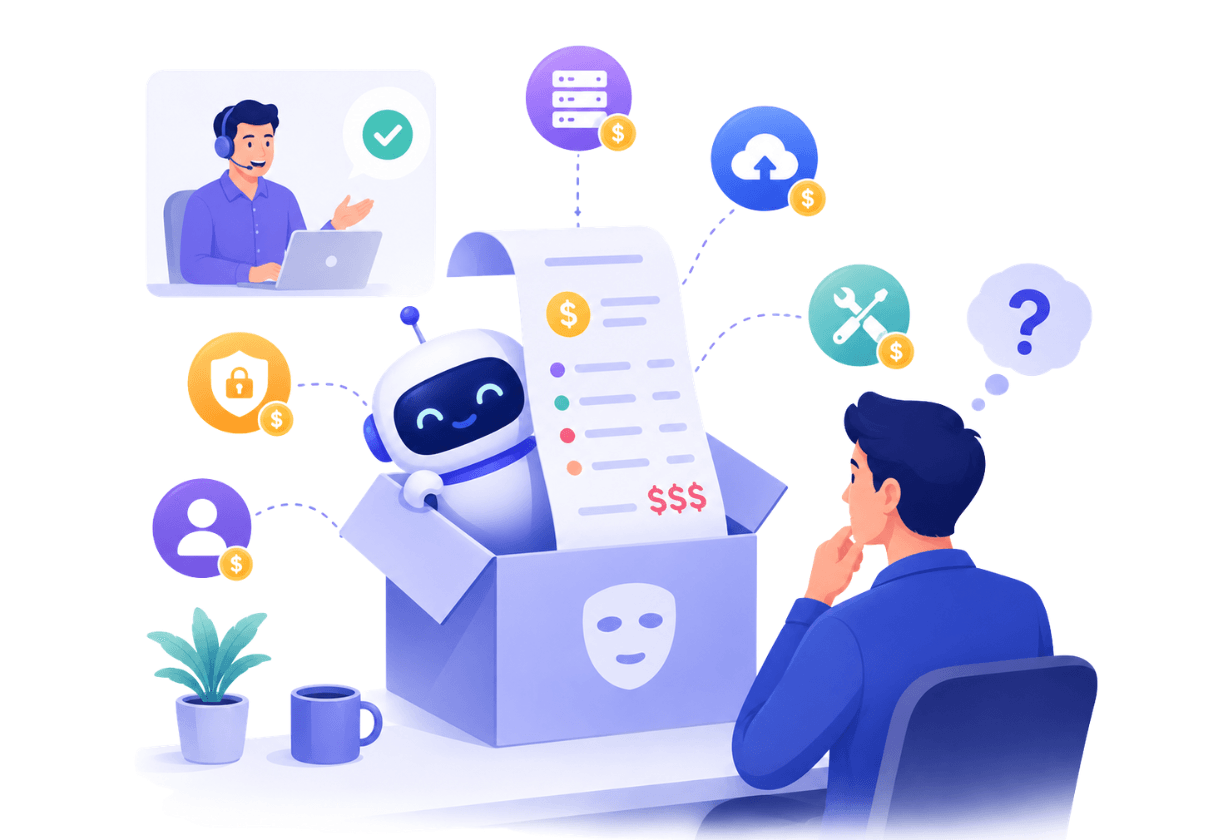
Every single founder I talk to budgets for the build and then gets blindsided by what shows up after launch. So let me just lay these out right now.
LLM API Costs
GPT-4 and Claude API calls add up scary fast when your agent processes thousands of interactions daily. A mid-traffic agent racks up $2,000 to $15,000 monthly in API costs alone. Some teams switch to open-source models like Llama or Mistral to control this. That works but you're trading API costs for hosting and fine-tuning costs instead.
Infrastructure and Hosting
Vector databases don't run for free. Neither do GPU instances, cloud storage for conversation logs, or monitoring dashboards. Budget $1,500 to $8,000 monthly depending on how much traffic your agent handles. This isn't optional. This is what keeps the lights on.
Ongoing Optimization
AI agents aren't ship-and-forget products. Models get updated and your prompts break. User patterns change and new edge cases pop up weekly. Budget 15 to 25% of your original build cost annually for maintenance, prompt updates, and performance tuning. Any ai agent development company that doesn't bring this up before you sign is hoping you won't ask until later.
The 18-Month Reality Check
That $80,000 mid-complexity agent? Over 18 months it's really $130,000 to $160,000 when you factor in API fees, infrastructure, and maintenance. That $250,000 enterprise system? It's $380,000 to $450,000 over the same period. Know these numbers before you start. Not after the first surprise invoice.
India vs USA: Where Should You Build Your AI Agent
This is the question nobody asks publicly but everyone asks privately. So I'll just address it.
US-Based Development
$120 to $200 per hour for senior AI engineers. A mid-complexity agent built entirely with a US team runs $150,000 to $250,000. You get time zone alignment and easier communication. You pay a significant premium for it.
India-Based Development
$30 to $65 per hour for engineers with the same LLM orchestration and infrastructure skills. That same mid-complexity agent? $55,000 to $95,000. We've built enough AI agents through this corridor to say the quality gap people assume exists mostly doesn't. What matters is the partner's production experience, not their geography.
The Hybrid Model Most Companies Actually Use
Onshore product lead or architect. Offshore engineering pod. This gives you strategic control locally with execution cost savings from the offshore team. Monthly cost: $15,000 to $35,000 for a 3 to 4 person pod. Most of our ai agents development services clients end up here because it balances cost, quality, and communication better than going fully one direction.
Which Engagement Model Makes Sense
Three models exist. Each one fits a different situation.
Dedicated Team - Best for Most AI Agent Builds
AI agents change constantly after launch. User feedback reveals new edge cases every single week. LLMs get updated and your prompts need adjusting. A dedicated team maintains context on your system and catches issues before they become production fires. Monthly cost runs $12,000 to $40,000.
Project-Based - Only for Simple, Fixed-Scope Agents
Building a basic internal chatbot with a defined knowledge base and no integrations? This works. Anything more complex and you'll hit scope changes the moment real users start talking to the agent. AI agents are inherently less predictable than traditional software. Fixed scope fights that reality.
Staff Augmentation - Only With Internal AI Leadership
Adding an LLM specialist to your existing team works beautifully when you already have someone internally who understands agent architecture and retrieval systems. Without that anchor, augmented engineers build disconnected pieces that don't form a working agent.
How We Evaluate AI Agent Development Partners
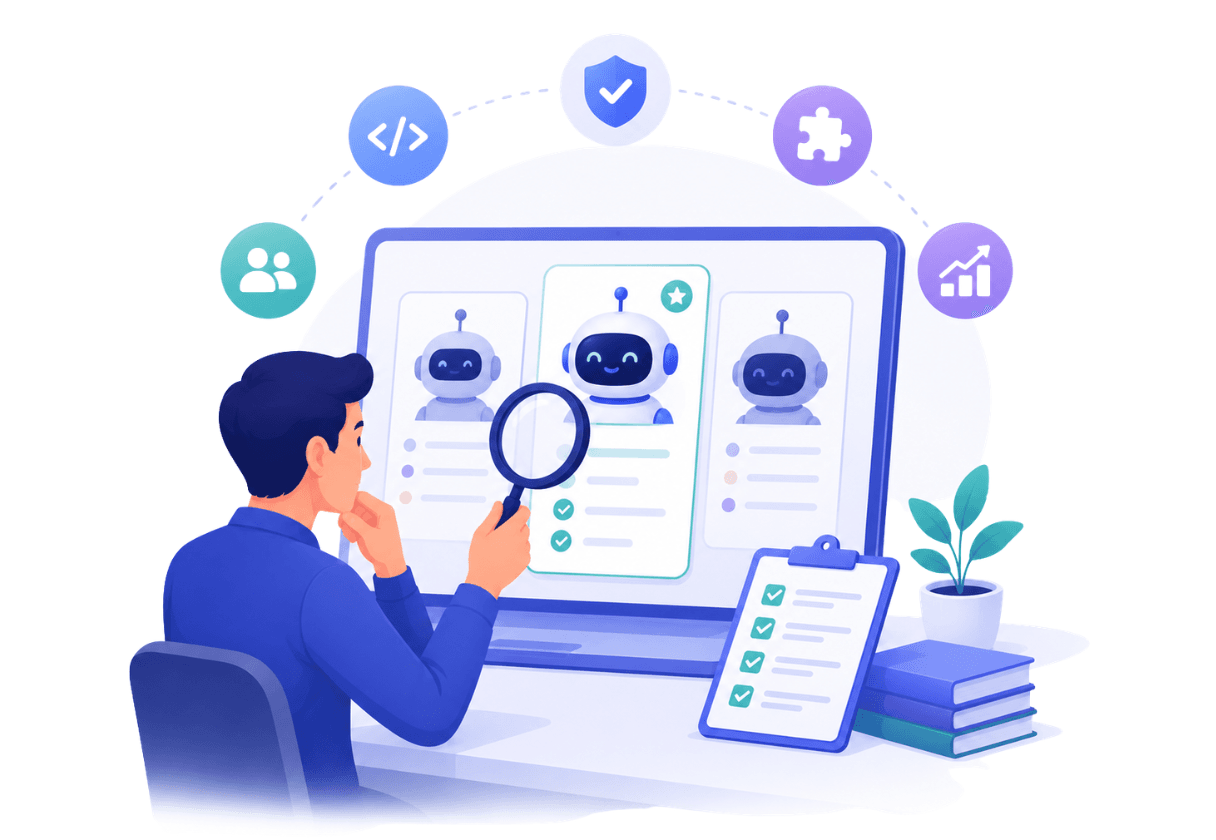
After shipping AI systems across conversational platforms, energy automation, and enterprise tools, we've gotten pretty direct about what separates real partners from hype merchants.
Four checks every time:
Production agents, not prototypes - Ask how many agents they've got running in production right now with real users. If the portfolio is all demos and proof-of-concepts, you're their learning project. Not their client. Full stack ownership - The LLM layer is one piece. Infrastructure, monitoring, guardrails, deployment are the rest. The best partners own everything. If they build the agent brain and expect you to figure out the body, you're buying half a product. Cost modeling before they start building - A strong partner estimates your monthly API costs, infrastructure spend, and maintenance budget before quoting the build. They tell you which decisions will be expensive at scale. Partners who skip this want you to find out later. A real post-launch plan - AI agents need continuous attention. Prompt updates, model migrations, performance tuning, edge case handling. Ask specifically what happens after launch day. "We hand it off" is a contractor answer, not a partner answer.
RemoteState's Client Success Story
One of our US clients needed an AI-powered platform that could predict energy consumption, automatically verify electricity bills for errors, and run a marketplace where users could share excess energy capacity with neighbors. Not a dashboard with charts. An autonomous system making real decisions about energy distribution and cost optimization for real people.
The Challenge
Building predictive AI models across diverse customer profiles and utility rate schedules. Integrating with multiple energy provider APIs. Handling secure payments. Delivering real-time analytics that actually helped people save money on their bills. Every piece of it had to work autonomously once configured.
What We Built
- Three engineers. One AI specialist, one backend developer, one operations lead. Seven months.
- AI demand prediction models trained on anonymized data from multiple energy providers, adjusting for seasonality and rate variations
- Automated bill verification that caught errors utility companies missed, saving users actual money every month
- Energy sharing marketplace connecting users with excess capacity to those who needed it
- Real-time analytics dashboards giving users insights they could actually act on
- Secure payment processing tied to live consumption data
Results
- 2,100+ users onboarded onto the platform
- 10% revenue growth driven by marketplace adoption
- Users reported real reductions in energy bills through AI-optimized recommendations
- Multi-provider data integration running without manual intervention
- Automated verification catching billing discrepancies users had been overpaying for years without knowing
The client was straightforward about it: RemoteState's technical depth and collaborative approach made energy sharing simple, secure, and impactful.
Frequently Asked Questions
How much does it cost to build an AI agent in 2026?
Basic agents run $25,000 to $80,000. Mid-complexity with integrations and multi-step workflows fall between $80,000 and $250,000. Enterprise multi-agent systems go past $250,000. But build cost is just the start. API fees, infrastructure, and maintenance add 40-60% over the first 18 months.
How long does AI agent development take?
Simple single-purpose agents take 3 to 4 months. Mid-complexity agents with integrations run 5 to 8 months. Enterprise systems with compliance requirements need 7 to 12 months. Anything under 3 months for more than a basic chatbot deserves serious scrutiny.
What's the difference between an AI chatbot and an AI agent?
A chatbot answers questions from a script or knowledge base. An AI agent reasons through problems, makes decisions, takes actions across your systems, and adapts based on context. A chatbot is a search bar. An agent is an employee that happens to be software.
How much does it cost to run an AI agent monthly after launch?
Monthly running costs range from $500 for basic agents to $15,000+ for enterprise systems. Biggest expenses are LLM API fees, cloud infrastructure, and monitoring tools. Most teams underbudget this by 40-60% because nobody mentioned it during the sales process.
Is it cheaper to build an AI agent in India or the USA?
India-based development runs 50-65% cheaper for equivalent quality. A mid-complexity agent costing $150,000 with a US team typically costs $55,000 to $95,000 with an experienced Indian partner like RemoteState. The quality difference people assume exists mostly doesn't when you pick the right team.
Should I use GPT-4, Claude, or open-source models?
Depends on budget and data sensitivity. GPT-4 and Claude deliver strong performance but API costs compound at scale. Open-source models like Llama or Mistral cost less per query but need hosting and fine-tuning. Most production agents in 2026 use a mix. Expensive models for hard reasoning. Cheaper ones for routine stuff.
How do I choose the right custom ai agent development services provider?
Look for production deployments, not demos. Ask about post-launch support. Verify they model your costs before quoting the build. Make sure they own the full stack including infrastructure and monitoring. Partners who only build the agent logic and disappear leave you holding the hardest part alone.
Conclusion
AI agent development in 2026 isn't cheap. But honestly the expensive part isn't the build itself. It's what happens when you underbudget the infrastructure, ignore the running costs, or hand the project to a team whose entire production experience is a demo they showed at a conference last year.
The founders who spend wisely on AI agents won't be the ones who found the lowest quote. They'll be the ones who understood the full 18-month cost picture before they committed, picked partners who've actually shipped agents that survived real users, and planned for everything that comes after launch day with the same seriousness they gave the build itself.
If you're scoping an AI agent and want to understand what it'll actually cost for your specific situation, RemoteState can walk you through it honestly.
AI agent development costs range from $25,000 to $500,000+ in 2026. Know the real pricing tiers, hidden costs, and how to budget without surprises.


