
Most businesses that struggle with healthcare app development don't struggle because they had a bad idea. They struggle because they picked the wrong partner to build it with.
Healthcare is not a normal software category. The compliance requirements are stricter, the integration complexity is higher, and the margin for error is genuinely narrower than almost any other industry. A feature that ships late in a SaaS product is annoying. A compliance gap in a healthcare product can shut your platform down entirely.
This guide walks you through how to evaluate and choose a healthcare app development company that can actually carry the weight of what you're building.
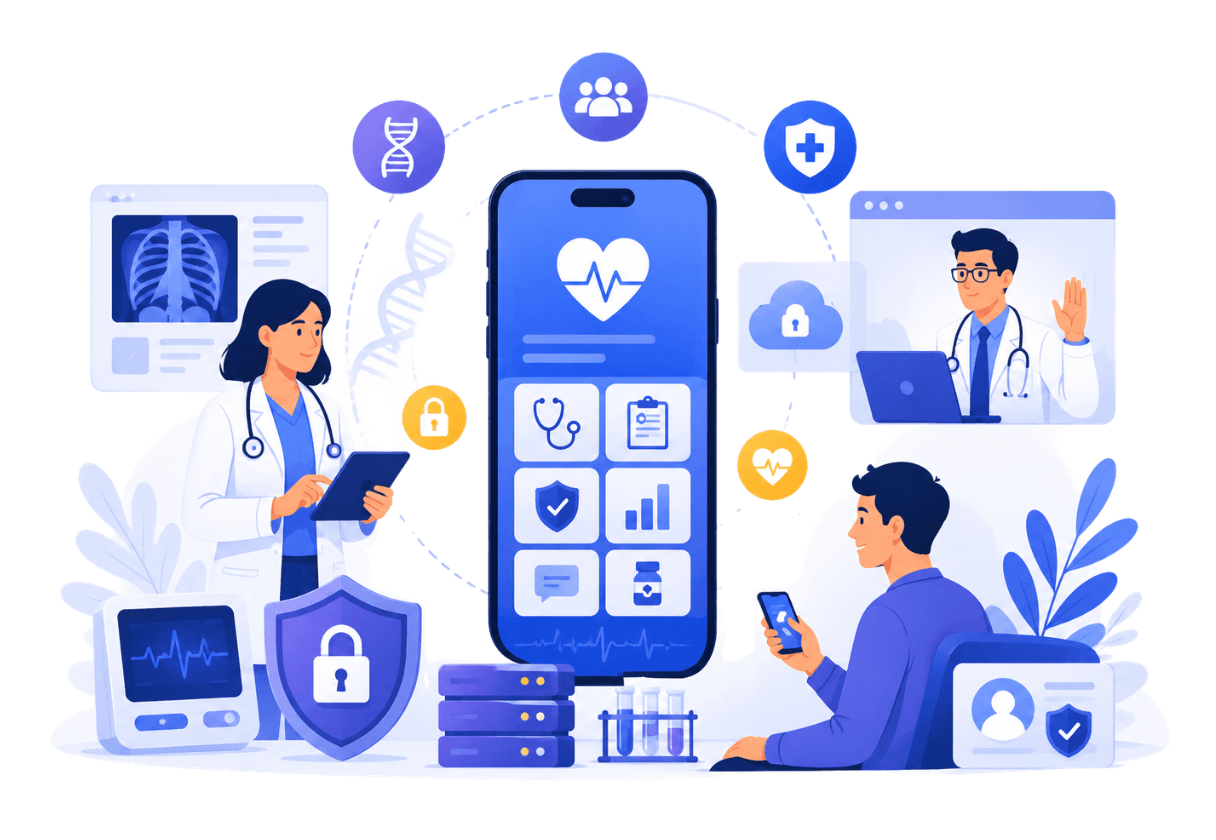
What Makes Healthcare App Development Different
Most software development challenges are technical. Healthcare adds a second layer that trips up even experienced engineering teams.
You're not just building a product that works. You're building one that handles protected health information, integrates with legacy hospital systems, satisfies HIPAA requirements, and earns the trust of medical professionals who have zero tolerance for tools that slow them down or put patient data at risk.
The companies that get this right treat compliance as architecture, not an afterthought. The ones that get it wrong usually realize it six months into development when the rework costs more than the original build.
How We Evaluate Healthcare App Development Companies
This guide isn't built on vendor marketing or directory listings. Our evaluation comes from working directly inside healthcare app development services across clinical workflow tools, patient engagement platforms, and medical data systems.
We assess partners across four criteria:
Compliance depth - Do they understand HIPAA, HL7, and FHIR from day one or learn on your dime
Integration experience - Have they actually connected to EMR systems and MedTech APIs before
Clinical workflow understanding - Do they know how doctors and nurses actually work or just what they've read about it
Security architecture - Is data protection built into the foundation or bolted on before launch
Any company that can answer all four with specifics and evidence is worth a serious conversation.
What to Look for in a Healthcare App Development Company
Choosing the right healthcare mobile app development company is the single most important decision you'll make before writing a line of code. Here's what actually separates the right partners from the ones that will cost you time and money.
HIPAA Compliance Is Non-Negotiable
Any company you consider must have a demonstrated track record with HIPAA compliant builds. Not theoretical knowledge. Actual shipped products that passed compliance review. Ask them directly which compliance frameworks they've worked within and how they handle data purging, consent flows, and audit trails. If the answers are vague, that's your answer.
EMR and Hospital System Integration Experience
Electronic medical record systems are notoriously difficult to integrate with. Every hospital runs different versions of different systems. A healthcare app development company USA that has done this before will tell you exactly which EMR platforms they've connected to and what the integration challenges looked like. One that hasn't will underestimate the timeline significantly.
A Team That Understands Clinical Environments
Software built without understanding how clinicians actually work almost always needs to be rebuilt. The best healthcare mobile app development teams start with workflow mapping sessions before they write a single line of code. They interview doctors, nurses, and administrators. They build around real clinical patterns, not assumptions.
Security Architecture Built From the Ground Up
Healthcare data breaches are among the most expensive in any industry. The right partner treats security as a structural decision made at the architecture stage, not a layer added before launch. Ask specifically how they handle data encryption, access controls, and scheduled purging of sensitive patient records.
Transparent Delivery Timeline
Healthcare builds almost always take longer than expected because of compliance reviews, integration complexity, and pilot testing in real clinical environments. A partner who gives you an honest timeline with a built-in buffer for regulatory feedback is more valuable than one who tells you what you want to hear.
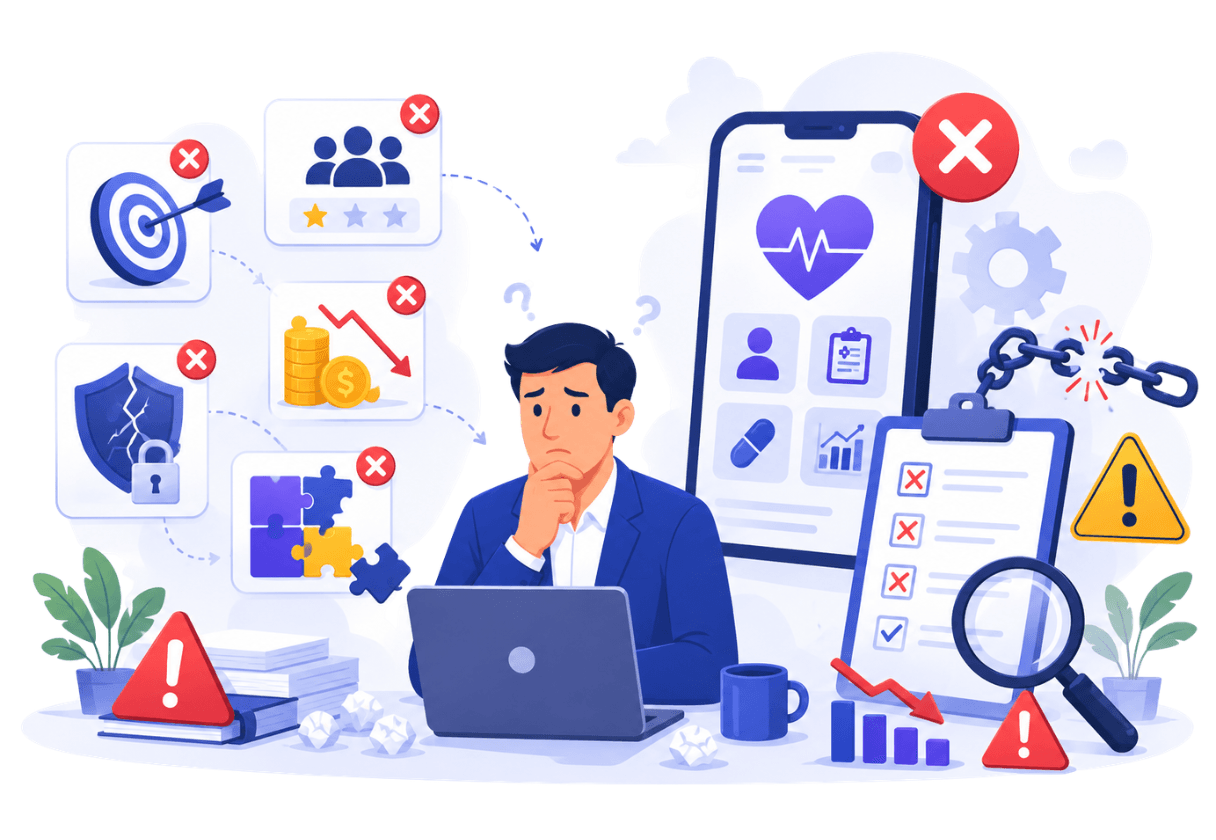
Common Mistakes Businesses Make When Hiring a Healthcare App Development Company
These patterns repeat constantly across companies that end up rebuilding products from scratch.
- Choosing a generalist agency over a specialist. General software shops can build apps. They can't always navigate HL7 interfaces, consent-based data mapping, or regional privacy variations without significant ramp-up time you're paying for.
- Underestimating compliance scope. HIPAA is the floor, not the ceiling. Depending on your market, you may also need to satisfy state-level regulations, international privacy frameworks, or hospital-specific data governance requirements.
- Skipping clinical workflow research. Products built without input from actual clinicians almost always miss the mark on usability. Doctors adopt tools that fit their workflow. They abandon tools that don't, regardless of how technically impressive they are.
- Treating integration as a late-stage task. EMR integration needs to be scoped and architected from day one. Teams that treat it as a phase two problem consistently run into timeline and budget problems that could have been avoided.
- No pilot deployment plan. Real clinical environments surface issues that testing environments never do. A proper partner builds pilot deployment into the project plan before full rollout.
What Good Healthcare App Development Services Actually Look Like
The best healthcare app development services combine technical depth with genuine understanding of how clinical environments operate. Here's what that looks like in practice:
- Modular backend architecture that can connect to multiple EMR systems without rebuilding core infrastructure
- Speech-to-text and AI capabilities built with medical terminology accuracy in mind, not general consumer use cases
- Compliance modules that handle data purging schedules, consent flows, and audit logging automatically
- Agile delivery with real clinical feedback loops built into each sprint
- Security reviews that happen continuously, not just at the end of the build
The difference between a healthcare product that gets adopted and one that doesn't usually comes down to whether the engineering team understood the clinical environment before they started building.
How RemoteState Approaches Healthcare App Development
RemoteState works with healthcare founders and product teams who need engineering partners that understand both the technical and regulatory complexity of building in this space.
The approach starts before any code is written. Clinical workflows get mapped. Compliance requirements get scoped. Integration dependencies get identified early so they don't become expensive surprises halfway through the build.
From there, healthcare mobile app development happens in modular, auditable stages. Security and compliance are architectural decisions, not final-stage additions. And pilot deployments with real clinical users happen before any full rollout.
The result is products that work in actual clinical environments, not just in staging.
RemoteState’s Client Success Story
The Challenge
A healthcare technology company set out to solve one of the most persistent problems in clinical settings: the sheer volume of manual documentation that pulls doctors away from patients. Clinicians were spending hours on data entry, chart updates, and prescription management tasks that added no clinical value but carried serious consequences if done incorrectly.
They needed a platform that could handle voice-activated clinical documentation, integrate with existing EMR and hospital systems, automate prescription charting using AI, and do all of it while satisfying strict healthcare data compliance requirements across multiple countries.
The Solution
RemoteState built the platform from the ground up with a focused three-person specialist team: a backend engineer, an AI/ML specialist, and an integrations lead. The team spent the first two weeks mapping real doctor workflows across clinics in Australia before writing a line of production code.
The platform they delivered included:
- Voice-activated transcription and medical charting using a resilient pipeline combining Microsoft voice services with custom AI models trained on clinical language
- EMR and practice management system integration with secure MedTech API connections and consent-based hospital data mapping
- AI-powered prescription suggestions using OpenAI automation balanced for clinical safety and regulatory guidance
- Automated compliance modules including a data purging scheduler and audit-ready consent flows built for multi-country deployment
- Hands-free navigation of patient records through natural language voice commands
The entire build from ideation to deployment ran across seven months: two weeks of ideation, four months of development, one month of testing, and two months of deployment.
Results
- Clinics reported meaningful reductions in manual documentation time, freeing doctors to spend more time on direct patient care
- Hands-free record management saw high adoption rates among medical professionals, which is notoriously difficult to achieve with new clinical tools
- Hospitals reported improved compliance and operational efficiency in medical data handling across all pilot environments
- The platform was architected for global deployment from day one, with compliance modules adaptable to regional privacy requirements across multiple countries
Want to see the complete project breakdown?
Frequently Asked Questions
What does a healthcare app development company do?
A healthcare app development company designs and builds digital health products including patient portals, clinical workflow tools, telemedicine platforms, and hospital management systems. The best ones combine software engineering with deep knowledge of HIPAA compliance, EMR integration, and clinical workflow requirements.
How much does healthcare app development cost?
Costs vary significantly based on complexity, compliance requirements, and integration scope. A basic HIPAA compliant patient-facing app typically starts around $50,000 to $100,000. Platforms with EMR integration, AI features, and multi-country compliance requirements can run significantly higher. The more important number is the cost of getting it wrong, which is almost always higher than the cost of building it properly the first time.
How long does it take to build a healthcare app?
A focused MVP with core compliance features typically takes four to seven months depending on integration complexity. Platforms requiring multiple EMR integrations, AI capabilities, and multi-region compliance frameworks take longer. Any timeline that doesn't include pilot deployment with real clinical users should be treated with skepticism.
What is HIPAA compliance and why does it matter for healthcare apps?
HIPAA sets the legal standard for how protected health information must be handled, stored, and transmitted in the US. Any app that touches patient data must meet these requirements. Non-compliance carries significant legal and financial penalties and can result in your platform being pulled from clinical use entirely.
How do I choose between a generalist agency and a specialist healthcare app development company USA?
If your product touches patient data, integrates with hospital systems, or operates in a regulated clinical environment, choose a specialist. The compliance and integration knowledge required in healthcare takes years to develop. A generalist agency learning on your project timeline is a risk most healthcare founders can't afford to take.
Conclusion
Choosing the right healthcare app development company is not a procurement decision. It's a product decision. The partner you pick determines whether your platform gets adopted by clinicians or abandoned, whether it passes compliance review or fails it, and whether your timeline holds or doubles. The checklist is straightforward. Compliance depth, EMR integration experience, genuine clinical workflow understanding, and security architecture built from the ground up. Any partner worth hiring can answer all four with specifics. If you're building a healthcare product and want a partner that has done this before, RemoteState is worth a conversation.
Top Healthcare App Development Company in USA delivering secure, HIPAA-compliant mobile solutions for hospitals, clinics, and healthcare startups.


